


- 31 Jul, 2026
- 1 Comment
- 15 Mins Read

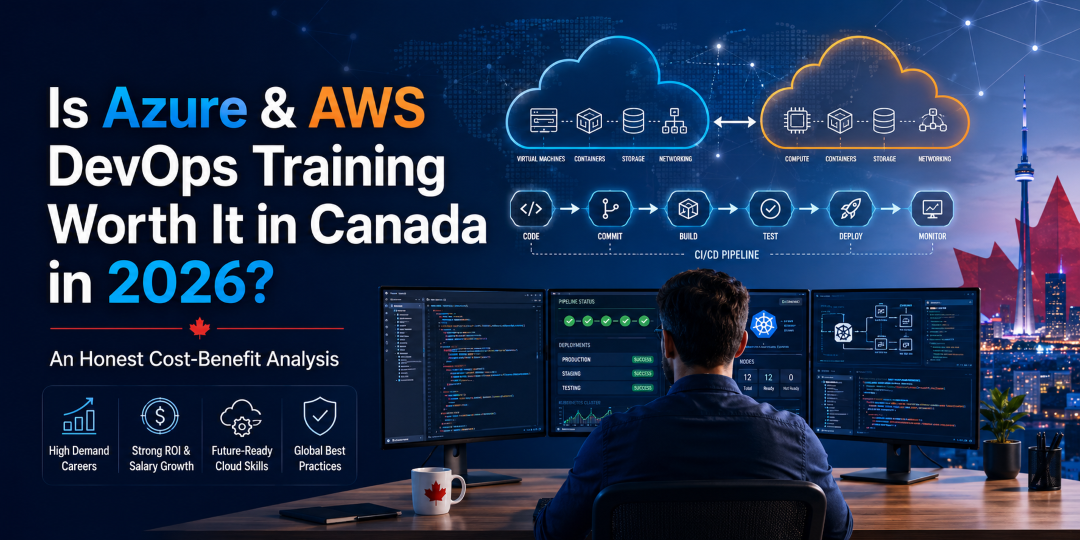
Is Azure and AWS DevOps Training Worth It in Canada in 2026?
For many Canadian IT professionals, the real question is not whether cloud computing and DevOps are growing. The more important question is whether investing time and money in an Azure and AWS DevOps training program can realistically improve their career prospects.
Will the training help you qualify for a better role? Are the advertised salary opportunities realistic? How long could it take to recover the cost of training through higher earnings?
The answer depends on your existing experience, the practical skills included in the program, the quality of your project portfolio, your location and how effectively you use the training during your job search.
For IT support professionals, system administrators, software developers and QA professionals, Azure and AWS DevOps training can be a valuable investment when it combines cloud administration, automation, CI/CD, containers, infrastructure as code and hands-on projects.
This guide provides an honest cost-benefit analysis of Azure and AWS DevOps training in Canada in 2026.
Is Azure and AWS DevOps Training Worth It?
Azure and AWS DevOps training may be worth the investment for professionals who already have some experience in IT infrastructure, software development, networking, cloud administration or quality assurance.
The training is most valuable when it helps you build practical skills rather than simply adding another certificate to your résumé.
Employers hiring for DevOps and cloud positions commonly look for candidates who can demonstrate experience with:
- Azure and AWS cloud services
- Git and collaborative development workflows
- Continuous integration and continuous delivery
- Docker and Kubernetes
- Terraform and infrastructure as code
- Cloud monitoring and observability
- Identity and access management
- DevSecOps practices
- Deployment automation
- Troubleshooting and incident response
Certification preparation can support your career development, but certification alone does not guarantee employment or a particular salary. Practical projects, relevant experience, technical interview preparation and the ability to explain your work remain essential.
Canada’s DevOps and Cloud Market in 2026
Canadian organizations continue to modernize applications, automate deployment processes and move infrastructure into public, private and hybrid cloud environments.
DevOps engineers help connect software development with IT operations. Their responsibilities may include automating builds and deployments, managing cloud resources, monitoring application performance, improving reliability and integrating security throughout the development lifecycle.
Robert Half’s 2026 Canadian salary data lists a national starting salary range of approximately CAD $105,500 to $163,000 for DevOps engineers, with a midpoint of approximately CAD $133,750. These figures are starting-salary projections rather than guaranteed salaries, and compensation varies based on experience, location, industry, technical skills and certifications. View the Robert Half DevOps salary data. Infrastructure spending also continues to grow globally. Synergy Research Group reported that worldwide cloud infrastructure service revenue reached approximately $128.6 billion in the first quarter of 2026, representing 35% year-over-year growth. During that quarter, Amazon held approximately 28% of the market, Microsoft held 21% and Google held 14%. Read the Synergy Research cloud-market report. obal market-share figures should not be interpreted as Canada-specific employment data. However, they demonstrate why knowledge of both AWS and Microsoft Azure can be relevant for professionals working with enterprise cloud environments.
Understanding the Potential Return on Investment
Calculating the ROI of an Azure/AWS DevOps course requires more than comparing the course fee with an advertised salary.
A useful calculation is:
Estimated ROI = Additional earnings after training − total training-related costs
Your total investment may include:
- Tuition
- Certification exam fees
- Cloud lab expenses
- Study materials
- Time away from paid work
- Transportation for in-person sessions
- Time spent completing projects and preparing for interviews
Your potential return may include:
- A higher salary
- Access to more specialized positions
- Improved promotion opportunities
- Greater eligibility for remote or hybrid roles
- Skills that can be used in freelance or consulting work
- Better preparation for technical interviews
Example One: IT Support Professional Moving Toward DevOps
Consider an IT support professional earning CAD $55,000 per year who spends CAD $6,000 on training, certification exams and related learning costs.
After completing the training, building projects and conducting a successful job search, the professional receives a cloud-support or junior DevOps position paying CAD $75,000 per year.
The annual salary difference would be CAD $20,000.
Based only on gross salary, the CAD $6,000 investment would be recovered after approximately 3.6 months of the additional earnings.
This is an illustrative calculation, not a promised result. Taxes, employment gaps, certification fees and the time required to secure a position would affect the actual break-even period.
Example Two: Software Developer Adding DevOps Skills
Consider a software developer earning CAD $85,000 per year who adds CI/CD, Terraform, Kubernetes, Azure and AWS deployment skills.
After completing the training and demonstrating these skills through practical projects, the developer secures a platform-engineering or DevOps-oriented position paying CAD $110,000 per year.
The annual salary difference would be CAD $25,000.
A CAD $6,000 training investment would theoretically be recovered after approximately 2.9 months of additional gross earnings.
Again, this example illustrates how the calculation works. It does not guarantee that every student will receive the same salary increase or secure a new position immediately after completing a course.
What Does an Azure and AWS DevOps Course Teach?
A comprehensive Azure/AWS DevOps course in Canada should help students understand how software moves from development into reliable, secure and monitored production environments.
The IIBS course page lists a 10-week curriculum covering CI/CD, containerization, infrastructure as code, deployment packages, testing, security, compliance, instrumentation, Kubernetes and Helm. It also identifies tools such as Azure DevOps, AWS CodeBuild, Jenkins, Terraform, Docker and Kubernetes. ps Foundations
Students should first understand the purpose of DevOps and how development, operations, quality assurance and security teams work together.
Core concepts may include the DevOps lifecycle, Agile integration, continuous feedback, automation, shared responsibility and the CALMS framework: Culture, Automation, Lean, Measurement and Sharing.
Version Control and Collaboration
Git is central to modern DevOps workflows. Students should learn how to create and manage repositories, branches, pull requests, merge processes and code reviews.
They may also work with platforms and services such as GitHub, Azure Repos and AWS source-control integrations.
Continuous Integration and Continuous Delivery
CI/CD training teaches students how to automate the building, testing and deployment of applications.
A practical program may include:
- YAML-based pipeline configuration
- Build and release stages
- Automated testing
- Deployment approvals
- Environment management
- Rollback strategies
- Artifact storage
- Secrets management
Students may work with Azure Pipelines, GitHub Actions, AWS CodePipeline, AWS CodeBuild, AWS CodeDeploy or Jenkins.
Containerization and Kubernetes
Containers help applications run consistently across development, testing and production environments.
Students should learn how to create Docker images, write Dockerfiles, manage container registries and troubleshoot containerized applications.
Kubernetes training may include deployments, services, namespaces, ConfigMaps, secrets, scaling and application updates. Cloud-specific services may include Azure Kubernetes Service and Amazon Elastic Kubernetes Service.
Infrastructure as Code
Infrastructure as code allows teams to create and manage cloud resources using reusable configuration files.
Terraform is widely used because it supports multiple cloud providers. Students may learn how to work with providers, resources, variables, modules, state files and workspaces.
A broader program may also introduce Azure Bicep, Azure Resource Manager templates and AWS CloudFormation.
Monitoring and Observability
Deploying an application is only one part of DevOps. Teams must also understand whether the application is available, secure and performing as expected.
Monitoring topics may include Azure Monitor, Log Analytics, Application Insights, Amazon CloudWatch, AWS CloudTrail, Prometheus, Grafana and centralized log management.
DevSecOps
DevSecOps integrates security checks throughout development and deployment rather than leaving security until the end of a project.
Students may learn about:
- Identity and access management
- Least-privilege permissions
- Azure Key Vault
- AWS Secrets Manager
- Static application security testing
- Dynamic application security testing
- Container-image scanning
- Dependency scanning
- Security and compliance checks in pipelines
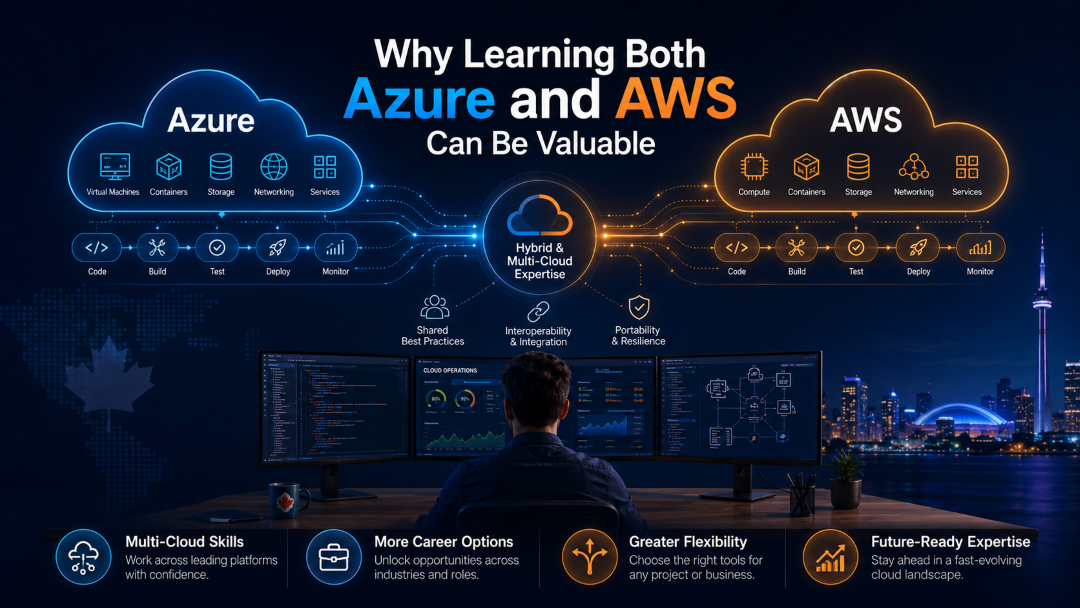
Why Learning Both Azure and AWS Can Be Valuable
Some students choose an AWS-only or Azure-only learning path. That can be appropriate when a current employer or target role clearly uses one platform.
However, many organizations operate hybrid or multi-cloud environments. A company may rely heavily on Microsoft 365, Active Directory and Azure while using AWS for selected applications, analytics workloads, backups or customer-facing services.
Learning both platforms can help students understand transferable cloud concepts, including:
- Compute
- Storage
- Networking
- Identity
- Monitoring
- Containers
- Infrastructure as code
- Deployment automation
- Security controls
Dual-platform knowledge does not automatically make someone an expert in both clouds. It can, however, help students compare services, understand common architecture patterns and adapt more easily when an employer uses more than one cloud platform.
Azure and AWS Certification Paths
An AWS certification training program can help students organize their studies, but candidates should always review the current certification requirements directly through AWS and Microsoft.
Certification names, exam objectives and prerequisite requirements can change.
AWS Certification Options
Professionals beginning their AWS journey may consider foundational or associate-level learning before attempting a professional-level DevOps examination.
The AWS Certified DevOps Engineer – Professional certification is designed for experienced professionals. AWS recommends two or more years of experience provisioning, operating and managing AWS environments before taking the DOP-C02 examination. Review the official AWS DevOps Engineer certification. AWS credentials may include:
- AWS Certified Cloud Practitioner
- An appropriate associate-level AWS certification
- AWS Certified DevOps Engineer – Professional
Students should select a certification based on their experience and career goals rather than attempting every available exam.
Microsoft Azure Certification Options
Students interested in Azure administration may begin with Azure fundamentals before progressing toward role-based certifications.
Relevant Microsoft credentials may include:
- AZ-900: Microsoft Azure Fundamentals
- AZ-104: Microsoft Azure Administrator
- AZ-400: Designing and Implementing Microsoft DevOps Solutions
Microsoft states that the DevOps Engineer Expert credential requires candidates to pass AZ-400 and hold an eligible prerequisite certification. Microsoft certification requirements are updated periodically, so students should verify the current path before registering for an exam. Review the official Microsoft DevOps Engineer Expert requirements. ly 31, 2026, Microsoft is retiring the AZ-204 exam and Azure Developer Associate certification pathway. Candidates planning an AZ-400 certification path should therefore confirm the latest prerequisites directly with Microsoft Learn. line Azure and AWS DevOps Training Effective?
An Azure AWS DevOps training online format can work well for employed professionals, newcomers and students living outside major Canadian cities.
DevOps work commonly involves remote-access tools, cloud consoles, Git repositories, deployment pipelines and online collaboration. This makes online learning compatible with many of the environments students may encounter in the workplace.
A strong online program should provide more than recorded videos. Look for:
- Live, instructor-led sessions
- Opportunities to ask technical questions
- Guided Azure and AWS labs
- Recorded sessions for revision
- Hands-on assignments
- Pipeline-building projects
- Troubleshooting exercises
- Instructor feedback
- Interview preparation
- Clear guidance about certification requirements
The IIBS course page describes the program as online and instructor-led and states that learners receive access to recorded sessions and course materials. It currently lists the program duration as 10 weeks. Prospective students should confirm the latest schedule, tuition, lab access and delivery format directly with IIBS before enrolling. an Benefit Most From DevOps Training?
System Administrators and Infrastructure Professionals
System administrators already understand operating systems, servers, networks, permissions, monitoring and troubleshooting.
Adding cloud infrastructure, Terraform, containerization and CI/CD skills can help them move toward cloud-administration, platform-engineering or DevOps responsibilities.
Software Developers
Developers who understand deployment automation and infrastructure can contribute beyond application code.
Skills such as Docker, Kubernetes, GitHub Actions, Azure Pipelines and Terraform may help developers qualify for platform engineering, site reliability engineering or DevOps-oriented positions.
QA and Software Testing Professionals
QA professionals can benefit from understanding how automated tests are integrated into delivery pipelines.
They may contribute to test automation, quality gates, containerized testing environments, deployment validation and production monitoring.
IT Support Professionals
IT support professionals may use DevOps training as a pathway toward cloud support, cloud operations or junior automation roles.
However, they may first need to strengthen their knowledge of Linux, networking, scripting, Git and cloud fundamentals.
Newcomers to Canada With IT Experience
Internationally trained professionals may use current Azure, AWS and DevOps skills to demonstrate familiarity with technologies used by Canadian employers.
Training can help them create current projects and prepare for technical interviews, but it does not replace previous experience or guarantee Canadian employment.
Career Beginners
Complete beginners can study DevOps, but the learning curve may be significant.
Before entering an advanced program, beginners may benefit from learning:
- Basic Linux administration
- Networking fundamentals
- Git
- One scripting language
- Cloud-computing fundamentals
- Basic software-development concepts
The IIBS course page currently contains different statements about prerequisites. One section says an administration or development background is required, while its FAQ says no prior experience is required. Prospective students should confirm the actual entry requirements with an advisor before enrolling. to Check Before Choosing a DevOps Course
Before paying for any Azure or AWS DevOps course, ask the training provider the following questions.
Does the course include real cloud labs? Watching demonstrations is not the same as configuring cloud resources yourself.
Will students build complete CI/CD pipelines? Projects should include source control, testing, deployment, monitoring and security rather than isolated exercises.
Are Azure and AWS costs included? Confirm whether cloud accounts, lab credits and software access are included in tuition.
Which certification objectives are covered? Ask for a written mapping between the course curriculum and current AWS or Microsoft exam objectives.
Does the tuition include certification exams? Training fees and certification-exam fees are often separate.
Who teaches the course? Review the instructor’s current technical experience, certifications and professional background.
What career support is included? Determine whether résumé assistance, LinkedIn optimization, interview preparation or job-search guidance is provided.
Are employment outcomes guaranteed? Be cautious of guaranteed salary, employment or placement claims. Ask for written terms and independently verifiable outcome data.
What is the refund policy? Review cancellation, withdrawal and refund terms before paying.
What are the prerequisites? Make sure your current technical background is appropriate for the pace and level of the course.
Why Consider IIBS for Azure and AWS DevOps Training?
The Azure and AWS DevOps Training Program at IIBS is designed to introduce learners to cloud-based DevOps practices across both Microsoft Azure and Amazon Web Services.
According to the current course page, the program includes:
- A 10-week curriculum
- Online, instructor-led delivery
- CI/CD pipeline concepts
- Infrastructure as code
- Terraform and CloudFormation
- Docker and Kubernetes
- Azure Monitor and Amazon CloudWatch
- Security and compliance planning
- Recorded sessions and course materials
- Career counselling and résumé preparation
The course page also states that the program prepares learners for Azure and AWS DevOps certifications. Students should confirm exactly which current certification exams are covered, whether examination fees are included and how much hands-on cloud-lab access is provided. ’s program-specific disclaimer states that this program does not require approval under the Ontario Career Colleges Act, 2005. This wording should be used instead of describing the individual program as approved or registered under the Act. tial Limitations of Azure and AWS DevOps Training
An honest analysis should also consider the limitations.
Training will not automatically make a beginner ready for a senior DevOps position. Senior roles normally require professional experience in cloud operations, software delivery, production troubleshooting, security and system architecture.
Completing multiple certifications without building projects may not significantly improve employability.
Learning two cloud platforms at the same time can also reduce depth. Students must continue practising after completing the program to develop stronger expertise in the platform most relevant to their target roles.
The employment market can vary by province, industry and economic conditions. Students may need to begin in cloud support, systems administration, application support, QA automation or junior platform roles before progressing into a dedicated DevOps position.
Frequently Asked Questions
What background is recommended for Azure and AWS DevOps training?
A background in systems administration, networking, IT support, software development, cloud administration or quality assurance can provide a strong foundation.
Comfort with Linux, networking, Git and basic scripting is helpful. Prospective IIBS students should confirm the current prerequisites directly because the existing course page contains inconsistent prerequisite information.
How long is the IIBS Azure and AWS DevOps course?
The current IIBS course page lists a duration of 10 weeks. Students should contact IIBS to confirm upcoming start dates, weekly class hours, delivery format and the amount of independent study required. I pass an AWS or Azure exam through self-study?
Yes. Many candidates prepare independently through official documentation, learning platforms, practice examinations and personal cloud projects.
Instructor-led training may help students who prefer a structured schedule, guided labs, direct feedback and access to an instructor.
Is Terraform included in the IIBS DevOps program?
The IIBS course page lists Terraform and infrastructure as code among the technologies and topics covered by the program. Prospective students should request a detailed syllabus showing the number and complexity of Terraform projects. is the difference between AZ-104 and AZ-400?
AZ-104 focuses on implementing, managing and monitoring Microsoft Azure environments.
AZ-400 focuses on designing and implementing DevOps solutions, including source control, build and release pipelines, security, compliance, collaboration and monitoring.
Students should verify Microsoft’s current certification prerequisites before registering because certification pathways can change.
Is AWS Certified DevOps Engineer – Professional suitable for beginners?
Generally, no. AWS recommends at least two years of experience provisioning, operating and managing AWS environments before attempting the professional-level certification.
Beginners may benefit from first building AWS fundamentals and practical associate-level skills. remote DevOps positions available in Canada?
Many Canadian cloud and DevOps positions are advertised as remote or hybrid, but availability depends on the employer, security requirements, province, experience level and the need to access physical infrastructure.
Candidates should not assume that certification automatically qualifies them for remote employment.
Will dual Azure and AWS knowledge increase my salary?
Dual-platform knowledge may increase the number of positions for which a candidate is technically relevant, especially in hybrid or multi-cloud environments.
However, there is no reliable universal percentage showing how much more a dual-platform professional will earn. Salary depends more broadly on experience, project complexity, technical depth, communication skills, location, industry and level of responsibility.
Final Verdict: Is Azure and AWS DevOps Training Worth the Investment?
Azure and AWS DevOps training can be a worthwhile career investment when it helps you develop practical, demonstrable skills.
The strongest candidates do more than complete a course. They build pipelines, deploy applications, write Terraform configurations, troubleshoot containers, configure monitoring and document their projects.
The investment may be particularly valuable for:
- System administrators moving into cloud operations
- Developers adding deployment and infrastructure skills
- QA professionals moving toward automation
- IT support professionals building a cloud career
- Internationally trained professionals updating their technical portfolio
Before enrolling, compare the tuition with the course duration, lab access, instructor experience, certification coverage and career support. Ask for written details and avoid basing your decision only on advertised salaries.
Azure and AWS certifications can strengthen your professional profile, but practical skills and relevant experience ultimately determine your career outcomes.
Ready to explore the curriculum?
View the Azure and AWS DevOps Training Program at IIBS or speak with an advisor about your technical background, course prerequisites, certification goals and upcoming schedules.
Salary figures, certification requirements and course details can change. Verify current information with the relevant employer, certification provider and training institution before making a financial or career decision.
Cloud Computing Skills Employers Want in Ontario 2026
[…] has a detailed guide on whether Azure and AWS DevOps training is worth it in Canada in 2026 for readers who want to explore that progression […]