


- 12 Aug, 2026
- 0 Comments
- 16 Mins Read

Supply Chain Certification vs SAP Training: Which Fits You in Canada in 2026?
Choosing between a Supply Chain Certification and SAP Supply Chain Training can be difficult, especially if you are trying to advance your career in Canada.
Should you pursue a broad professional credential such as APICS CPIM, APICS CSCP or SCMP, or should you develop practical enterprise-system skills through SAP S/4HANA training?
The answer depends largely on where you are in your career.
Traditional supply chain certifications are primarily designed to strengthen your understanding of planning, procurement, inventory, operations and end-to-end supply chain strategy. SAP training, on the other hand, helps you learn how many of those business processes are executed inside an enterprise technology environment.
For experienced procurement, logistics and supply chain professionals, these two paths do not necessarily compete with each other. In many cases, they complement each other.
This guide compares Supply Chain Certification vs SAP Training in Canada in 2026, including the skills each pathway develops, potential career directions, salary considerations and which option may make the most sense for your background.
Supply Chain Certification vs SAP Training: Quick Comparison
| Factor | Traditional Supply Chain Certification | SAP Supply Chain Training |
| Primary focus | Supply chain concepts and strategy | ERP-enabled supply chain processes |
| Examples | CPIM, CSCP, SCMP | SAP MM, EWM, Ariba, IBP, TM |
| Best suited for | Planning, operations, procurement and management professionals | Procurement, warehouse, ERP and consulting professionals |
| Technical system skills | Limited | Strong SAP-specific focus |
| Process knowledge | Strong | Process knowledge within SAP |
| Consulting pathway | Indirect | More directly aligned |
| Management pathway | Strong | Strong when combined with industry experience |
| Ideal outcome | Broader supply chain expertise | Business-process + SAP system expertise |
The simple answer
Choose a traditional supply chain certification if: you primarily need stronger supply chain methodology, planning knowledge or management credentials.
Choose SAP Supply Chain Training if: you already understand supply chain processes and need practical ERP skills for procurement, warehouse management or SAP-related positions.
Consider both if: you want to build long-term expertise combining business strategy with enterprise technology.
Why Supply Chain Skills Are Changing in Canada
Supply chain careers are increasingly connected to technology.
Procurement teams need better visibility into purchasing and supplier activity. Warehouses depend on real-time inventory information. Planning teams use integrated systems to coordinate demand, supply and materials. Large organizations increasingly expect supply chain professionals to work comfortably with ERP platforms and business data.
SAP itself groups sourcing and procurement, Extended Warehouse Management, transportation management, planning and manufacturing among its major supply chain learning areas.
That means employers may value two different types of competency:
- Understanding how supply chains should operate
- Understanding how those processes are executed through enterprise systems
This distinction is important when deciding between a professional supply chain certification and an SAP S/4HANA MM Sourcing and Procurement course.
What Traditional Supply Chain Certifications Teach
Several professional credentials are commonly considered by Canadian supply chain professionals.
APICS CPIM
The Certified in Planning and Inventory Management (CPIM) credential is offered through ASCM.
It is particularly relevant for professionals interested in areas such as:
- Planning
- Inventory management
- Operations
- Materials management
- Production environments
- Demand and supply coordination
CPIM can be particularly useful if you want to strengthen the process foundation behind manufacturing, inventory or planning decisions.
ASCM continues to list CPIM as one of its professional APICS certification programs.
APICS CSCP
The Certified Supply Chain Professional (CSCP) credential takes a broader end-to-end view of supply chain management.
The current 2026 CSCP framework covers areas including supply chains, demand management, forecasting and broader integrated supply chain topics.
CSCP may suit professionals looking to move toward:
- Supply chain management
- Strategic sourcing
- Operations leadership
- Supply chain transformation
- End-to-end supply chain roles
It is generally broader than a platform-specific technology course.
SCMP in Canada
Canadian professionals may also consider the Supply Chain Management Professional (SCMP) designation offered by Supply Chain Canada.
Supply Chain Canada describes SCMP as its principal professional supply chain designation. Its program covers areas including procurement, logistics, operations, global sourcing, public-sector supply chain management and strategic supply chain management.
This can make SCMP especially relevant to professionals pursuing leadership or strategic supply chain careers within Canada.
What Traditional Supply Chain Certifications Do Well
A professional Supply Chain Certification can help you:
- Build structured supply chain knowledge
- Understand planning and inventory principles
- Strengthen procurement and operations knowledge
- Develop a broader view of the end-to-end supply chain
- Build credibility for management-oriented roles
- Understand supply chain strategy beyond one software platform
These credentials can be particularly valuable when your goal is to become a stronger supply chain professional rather than specialize immediately in one enterprise system.
What Traditional Certifications Usually Don’t Teach
A certification such as CPIM, CSCP or SCMP should not be confused with ERP implementation training.
Traditional certifications generally do not focus on teaching you how to configure or execute business processes inside SAP S/4HANA.
For example, knowing how procurement should operate conceptually is different from knowing how to work with:
- Purchase requisitions
- Purchase orders
- Material master data
- Vendor or business partner data
- Goods receipts
- Inventory transactions
- Invoice verification
- Procurement configuration
inside SAP.
This is where SAP Supply Chain Training serves a different purpose.
What Is SAP Supply Chain Training?
SAP Supply Chain Training develops skills around the technology businesses use to manage supply chain processes.
Rather than studying supply chain management only at a conceptual level, learners work with specific SAP solutions and processes.
Common areas include:
SAP S/4HANA Sourcing and Procurement / MM
SAP sourcing and procurement skills are particularly relevant to purchasing, procurement, materials and inventory functions.
Professionals interested in this area can explore IIBS’s SAP S/4HANA MM Sourcing and Procurement Training.
The IIBS course focuses on material management, sourcing and procurement skills for professionals seeking to apply SAP S/4HANA within supply chain environments.
Career areas may include:
- Procurement
- Purchasing
- Materials management
- Inventory management
- SAP functional consulting
- Supply chain analysis
SAP Extended Warehouse Management — EWM
SAP EWM focuses more directly on sophisticated warehouse and logistics operations.
SAP describes EWM as technology for managing warehouse processes, including inventory visibility, goods movement and complex warehouse operations.
Professionals interested in warehouse technology can also explore the SAP S/4HANA EWM course at IIBS.
Potential areas of application include:
- Inbound logistics
- Outbound logistics
- Warehouse structures
- Putaway
- Picking
- Physical inventory
- Warehouse monitoring
- Storage-bin management
SAP Ariba
SAP Ariba is associated with digital procurement and supplier collaboration.
Depending on the position, knowledge of Ariba can complement SAP sourcing and procurement knowledge, particularly for professionals involved in strategic sourcing, supplier processes and procurement transformation.
SAP Integrated Business Planning — IBP
SAP IBP is more closely aligned with areas such as:
- Demand planning
- Supply planning
- Inventory planning
- Sales and operations planning
- Integrated business planning
It may be more appropriate for planning professionals than someone primarily focused on purchasing transactions.
SAP Transportation Management — TM
SAP TM supports transportation and freight-management processes.
It can be relevant for professionals working in:
- Transportation planning
- Logistics
- Freight management
- Carrier operations
- Distribution
The important point is that SAP supply chain is not one single module. Your ideal specialization should reflect the business function you already understand—or want to build a career in.
SAP MM vs EWM vs Other SAP Supply Chain Areas
A practical way to choose is to map your current background to the SAP specialization.
| Your Background | SAP Area to Consider |
| Procurement / purchasing | SAP S/4HANA Sourcing & Procurement / MM |
| Inventory / materials | SAP MM |
| Warehouse operations | SAP EWM |
| Logistics / freight | SAP TM |
| Demand planning | SAP IBP |
| Supplier sourcing | SAP Ariba |
| Manufacturing | SAP production-planning related learning |
If procurement is your main focus, start by exploring the SAP S/4HANA MM Sourcing and Procurement course.
If warehousing is your primary area, the SAP S/4HANA EWM training program may be more closely aligned.
Supply Chain Certification vs SAP Training: Which Is Better for You?
There is no universal winner.
The best choice depends on your starting point.
Scenario 1: You’re New to Supply Chain
If you have little or no supply chain experience, begin by understanding the business processes themselves.
Learn concepts such as:
- Procurement
- Inventory
- Logistics
- Planning
- Warehousing
- Supplier management
- Supply chain KPIs
A broad supply chain program or CPIM-style learning path can provide useful context.
Once you understand the business processes, SAP becomes easier to understand because you know why the transactions and configurations exist.
Another option is a structured program combining both business and technology learning, such as the Diploma in Supply Chain Management – SAP Specialization.
Scenario 2: You Have 3–7 Years of Supply Chain Experience but No SAP Skills
This is one of the strongest use cases for SAP Supply Chain Training.
Suppose you already understand:
- Purchase orders
- Supplier management
- Inventory
- Goods receipt
- Warehousing
- Procurement approvals
- Planning
Your knowledge of the business process already exists.
What may be missing is the ability to understand how those activities operate inside an enterprise ERP environment.
For procurement professionals, an SAP S/4HANA MM Sourcing and Procurement course can help add that technology layer.
For warehouse professionals, SAP EWM may be a better fit.
You can also read IIBS’s guide on how Canadian procurement is being rebuilt around SAP and digital procurement for additional career context.
Scenario 3: You’re Already an SAP MM Professional
If you already work with SAP MM, repeating introductory MM training may provide limited additional value.
Instead, you could expand your skills into adjacent areas such as:
- SAP EWM
- SAP Ariba
- SAP TM
- SAP IBP
- Cross-module integration
- SAP analytics
- SAP AI capabilities
Adding business credentials such as CSCP can also help you develop a broader strategic supply chain perspective.
Your goal at this stage is not simply to collect certifications. It is to increase the range and complexity of business problems you can solve.
You can explore the broader SAP training programs available at IIBS to compare related specializations.
Scenario 4: You’re a Supply Chain Manager Who Wants to Move Into SAP Consulting
Your domain experience can be particularly useful here.
Many technology projects require people who understand both the business requirement and the enterprise system supporting it.
For example:
Procurement Manager → SAP Sourcing & Procurement / MM
Warehouse Manager → SAP EWM
Demand Planner → SAP IBP
Transportation Manager → SAP TM
Instead of starting your professional knowledge from zero, SAP training can help translate your existing operational expertise into ERP-oriented skills.
That combination can help position you for functional analyst, business systems or consulting-oriented opportunities.
APICS vs SAP in Canada: The Biggest Difference
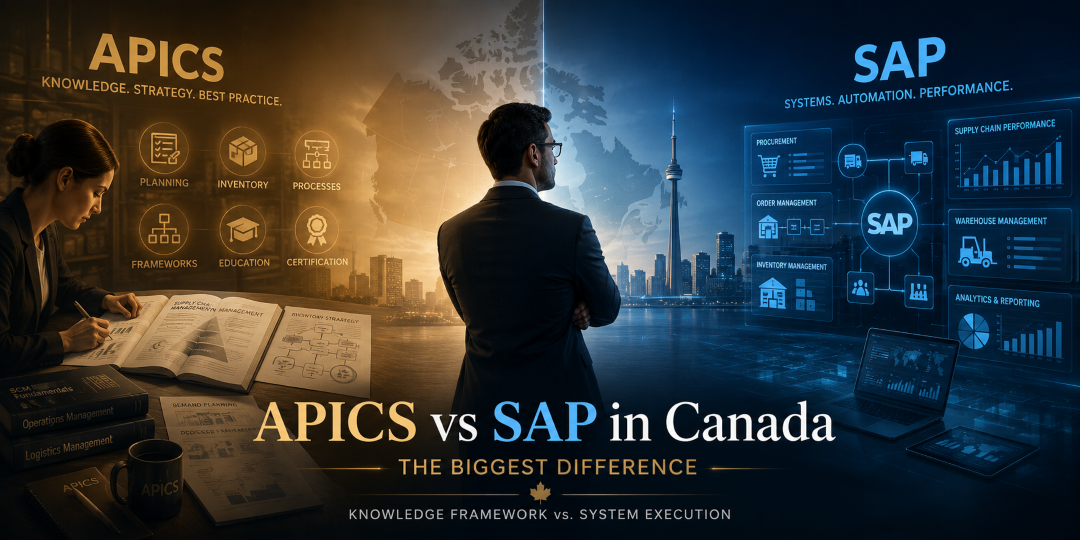
One of the easiest ways to understand APICS vs SAP in Canada is to look at the question each one answers.
APICS/ASCM asks:
Do you understand how supply chains should be planned and managed?
SAP training asks:
Can you understand and work with those processes inside an SAP environment?
For many experienced professionals, the strongest long-term profile is therefore not:
APICS OR SAP
but:
Domain Knowledge + Professional Certification + Enterprise Technology Skills
The sequence depends on where you start.
What About Salary? Supply Chain vs SAP Careers in Canada
Salary is important, but it should not be the only reason for choosing a certification.
Compensation varies substantially based on:
- Years of experience
- Province
- Industry
- Employer
- Functional specialization
- Project experience
- Permanent vs contract employment
- Management responsibility
- Technical depth
For broader context, the Government of Canada’s Job Bank currently reports Canadian supply chain manager wages ranging from approximately C$39.34 to C$86.54 per hour, with a national median of C$56.11 per hour.
SAP compensation also varies considerably. Current Canadian postings illustrate that specialized senior SAP roles can reach six-figure salary ranges; for example, current SAP MM-related listings include senior roles around C$95,000–C$145,000, while specific SAP EWM senior-consultant postings have advertised broad ranges such as C$80,000–C$155,000. These are examples of job postings rather than guaranteed market salaries.
The key takeaway is therefore not that an SAP certificate automatically increases someone’s salary.
It doesn’t.
Higher compensation usually comes from the combination of experience, business-process expertise, SAP capability, project exposure and level of responsibility.
Is Combining SAP and Supply Chain Certification Worth It?
For many mid-career professionals, yes.
Consider these profiles:
Profile A: CPIM + SAP MM
Strong fit for:
- Materials planning
- Procurement
- Inventory
- Manufacturing supply chain
- ERP transformation
Profile B: CSCP + SAP
Strong fit for:
- End-to-end supply chain transformation
- Consulting
- Supply chain technology
- Process improvement
- Program leadership
Profile C: SCMP + SAP
Potentially valuable for Canadian professionals combining strategic supply chain knowledge with enterprise technology competency.
Profile D: Industry Experience + SAP EWM
Strong fit for warehouse professionals moving toward warehouse systems, functional analysis or SAP consulting.
A credential may help demonstrate knowledge. Practical experience is what helps demonstrate your ability to apply it.
What to Look for in an SAP Supply Chain Management Course in Canada
Not every SAP Supply Chain Management Course should be evaluated only by the number of topics listed in its curriculum.
Look for training that helps you connect business processes to system activity.
A strong program should ideally cover:
1. Business Process Understanding
You should understand the complete process rather than memorizing screens.
For procurement, that can include:
Requirement → Requisition → Sourcing → Purchase Order → Goods Receipt → Invoice
2. Practical System Exposure
Watching demonstrations alone is different from actually performing transactions and working through business scenarios.
3. Configuration Concepts
Professionals pursuing functional SAP careers should understand why SAP is configured in a particular way—not simply which buttons to click.
4. Integration
Supply chain processes rarely operate in isolation.
Procurement interacts with finance. Warehouse processes interact with purchasing and sales. Planning influences materials and inventory.
Cross-functional understanding becomes increasingly important as your career progresses.
5. Career Alignment
Your course should match your intended role.
Someone pursuing warehouse technology does not need the same specialization as someone pursuing strategic sourcing.
SAP Supply Chain Training at IIBS
IIBS offers an SAP S/4HANA MM Sourcing and Procurement course focused on material management, sourcing and procurement skills within SAP S/4HANA.
For professionals interested in warehouse operations, IIBS also offers SAP S/4HANA EWM Training.
Professionals who want a broader academic path combining supply chain topics with SAP specialization can explore the Diploma in Supply Chain Management – SAP Specialization. The program identifies career possibilities including procurement, supply chain analysis, logistics and SAP-related roles.
You can also review IIBS’s analysis of SAP MM skills and Canada’s changing supply chain environment before deciding which specialization best matches your experience.
SAP Certification in 2026
One area where prospective learners should be careful is certification naming.
SAP certification names and assessment structures can change over time. Instead of relying on old exam codes found in older blogs, always verify the current certification directly with SAP Learning before registering for an exam.
For sourcing and procurement, SAP currently lists SAP Certified – SAP S/4HANA Cloud Private Edition, Sourcing and Procurement.
For EWM, SAP currently lists SAP Certified – SAP S/4HANA Cloud Private Edition, Extended Warehouse Management.
SAP has also moved to a certification model that requires certified professionals to keep eligible credentials current through ongoing assessments.
Always check SAP’s current certification requirements before scheduling an examination.
Procurement Training in Ontario: Who Should Consider SAP MM?
SAP MM and sourcing and procurement training can be particularly relevant if you currently work—or want to work—in areas such as:
- Purchasing
- Procurement
- Inventory control
- Materials management
- Manufacturing
- Supply chain operations
- Vendor management
- ERP support
- Business systems
- Functional consulting
Professionals seeking procurement training in Ontario should evaluate whether they primarily need procurement fundamentals, a professional designation or hands-on ERP competency.
The answer may lead to very different training choices.
Diploma in Supply Chain Management – SAP Specialization
For learners who do not want to choose between broader supply chain knowledge and SAP technology immediately, a diploma pathway can provide a more structured combination.
IIBS offers a Diploma in Supply Chain Management – SAP Specialization designed around supply chain and SAP-oriented career preparation.
This type of pathway may appeal especially to:
- Career changers
- Newcomers to supply chain
- Professionals seeking structured training
- Learners wanting both business and ERP exposure
Experienced supply chain professionals may instead prefer a focused SAP module if they already have strong domain knowledge.
Frequently Asked Questions
Is SAP supply chain training better than APICS certification in Canada?
Neither is universally better.
APICS certifications such as CPIM and CSCP focus primarily on supply chain knowledge and professional competency. SAP training focuses on applying business processes through SAP technology.
If you already have several years of supply chain experience but lack ERP skills, SAP training may fill the more immediate skills gap.
If you are new to supply chain, broader process education may be a better starting point.
Is SAP MM useful for supply chain professionals?
Yes. SAP sourcing and procurement functionality is directly relevant to purchasing, materials management, procurement and inventory-related business processes.
For professionals in these areas, learning SAP can help connect existing business knowledge with ERP technology.
Which SAP module is best for supply chain?
It depends on your specialization.
Procurement: SAP MM / Sourcing and Procurement
Warehousing: SAP EWM
Planning: SAP IBP
Transportation: SAP TM
Strategic sourcing and supplier processes: SAP Ariba
There is no single SAP module that is best for every supply chain professional.
Can beginners take SAP Supply Chain Training?
Yes, although understanding basic procurement, inventory, logistics and supply chain terminology can make SAP concepts easier to learn.
Complete beginners may benefit from first building foundational supply chain knowledge or choosing a structured program such as the Diploma in Supply Chain Management – SAP Specialization.
Can SAP training help me become an SAP consultant?
SAP training can provide part of the knowledge required for consulting, but completing a course alone does not automatically make someone an SAP consultant.
Consulting roles may also require:
- Business-process expertise
- Configuration knowledge
- Project exposure
- Integration understanding
- Communication skills
- Problem-solving ability
Practical experience becomes increasingly important as you progress.
Is SAP certification required to get an SAP job?
Not always.
Requirements vary by employer and role. Certification can help demonstrate formal knowledge, while employers may also place significant value on relevant SAP project experience and domain expertise.
Is SAP Supply Chain Training available for professionals in Canada?
Yes. Professionals can pursue SAP learning across areas including sourcing and procurement and Extended Warehouse Management. IIBS also offers SAP-focused training options for learners seeking a Canadian training provider.
Explore the complete SAP course selection at IIBS.
Supply Chain Certification vs SAP Training: Final Verdict
So, which should you choose in 2026?
If you’re completely new to supply chain:
Build strong process fundamentals first. Consider a structured supply chain program before specializing too narrowly.
If you already work in supply chain but lack SAP experience:
SAP Supply Chain Training may be the stronger next step.
Your business knowledge gives you context; SAP training can add the enterprise-technology layer.
If you’re already working with SAP:
Expand into complementary modules, integration, analytics or broader supply chain credentials instead of repeating foundational training.
If you’re a supply chain manager considering consulting:
Map your current domain to the appropriate SAP specialization.
Procurement → SAP MM
Warehouse → SAP EWM
Planning → SAP IBP
Transportation → SAP TM
If your goal is long-term leadership:
Combining supply chain expertise with enterprise technology skills can give you a broader professional profile than either pathway alone.
The best career strategy is rarely about collecting the greatest number of certifications.
It is about building the right combination of business knowledge, technology skills and practical experience for the role you actually want.
Ready to Explore SAP Supply Chain Training?
If procurement, sourcing or materials management aligns with your career goals, explore the SAP S/4HANA MM Sourcing and Procurement Course at IIBS.
For broader supply chain and SAP learning, explore the Diploma in Supply Chain Management – SAP Specialization.
Interested in warehouse technology? Review the SAP S/4HANA EWM Course.
You can also learn more about IIBS placement services and career management support when planning your next career step.
Traditional supply chain certification builds broad professional knowledge. SAP training builds enterprise-system capability. For many professionals, the strongest career profile combines both.