


- 22 Jul, 2026
- 0 Comments
- 12 Mins Read

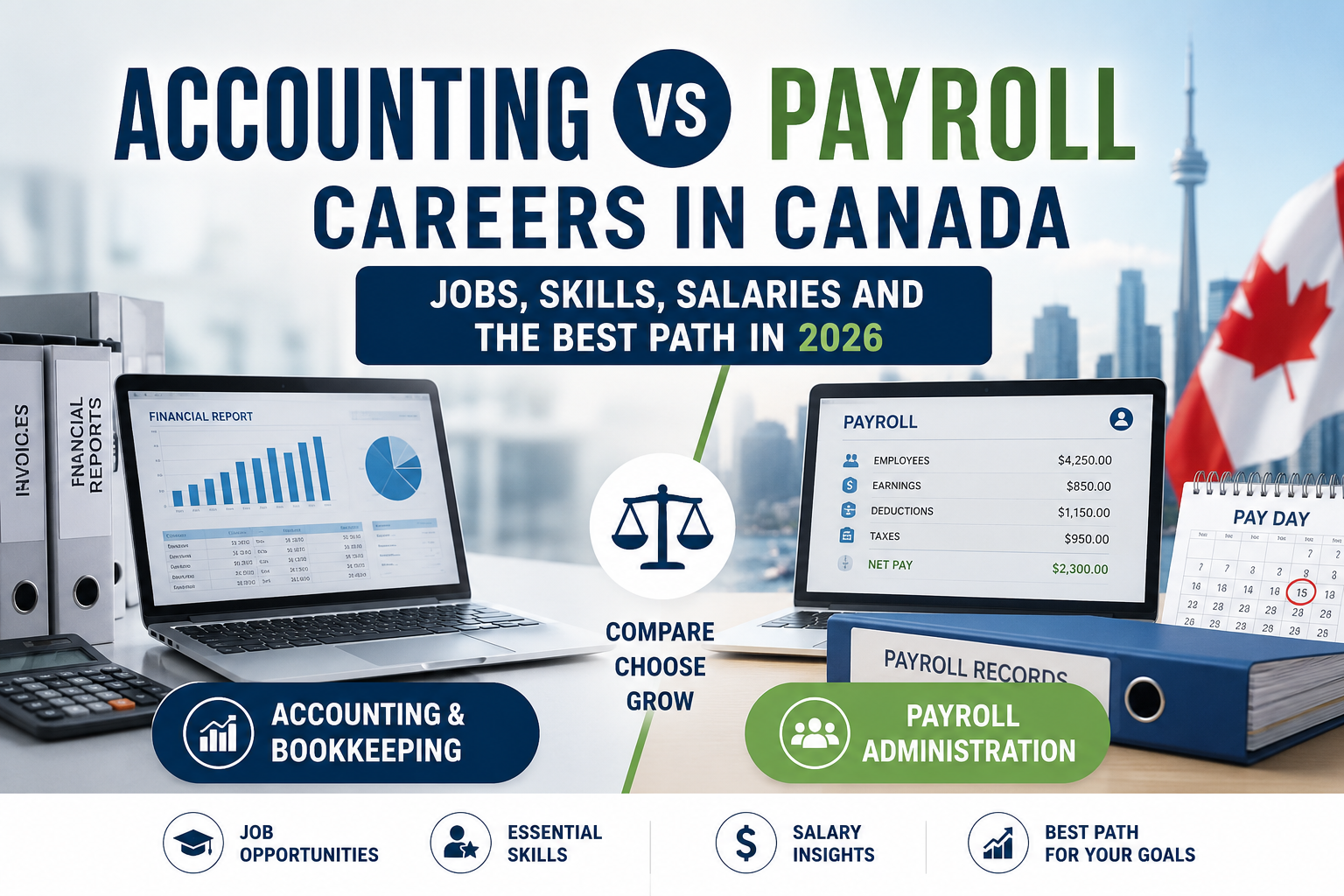
Accounting vs Payroll Careers in Canada: Jobs, Skills, Salaries and the Best Path in 2026
Accounting and payroll are closely connected business functions, but they lead to different day-to-day responsibilities and career paths.
Accounting professionals help businesses record transactions, reconcile accounts, prepare financial reports and understand their financial position. Payroll professionals focus more specifically on calculating employee pay, deductions, benefits, vacation entitlements and statutory remittances.
For newcomers, career changers and working professionals in Canada, both fields can offer practical career opportunities. Accounting vs Payroll Career Canada The better choice depends on whether you prefer broad financial recordkeeping or specialized employee-pay compliance.
Accounting vs Payroll Careers: The Quick Answer
Choose an accounting or bookkeeping path when you enjoy working with financial records, reconciliations, accounts payable, accounts receivable and business reporting.
Choose a payroll path when you prefer structured pay cycles, employment records, deductions, benefits and Canadian payroll legislation.
Choose a Diploma in Accounting, Payroll, and Financial Technology Canada when you want access to a broader range of entry-level finance and administration opportunities.
Accounting vs Payroll at a Glance
| Area | Accounting and Bookkeeping | Payroll Administration |
| Primary focus | Recording and reporting business transactions | Paying employees accurately and on time |
| Common responsibilities | Bookkeeping, reconciliations, invoices and financial records | Earnings, deductions, benefits, taxes and payroll records |
| Common job titles | Bookkeeper, accounting technician, accounting clerk, accounts payable clerk | Payroll administrator, payroll clerk, pay and benefits administrator |
| Important skills | Numeracy, accuracy, organization and financial reporting | Accuracy, confidentiality, compliance and deadline management |
| Common software | QuickBooks, Sage, Excel and other accounting systems | Payroll platforms, HR systems, Excel and accounting software |
| Career flexibility | Broad opportunities across industries and self-employment | Specialized roles across organizations with employees |
| Ontario outlook | Good for 2025–2027 | Moderate for 2025–2027 |
| Ontario median wage | Approximately $28.50 per hour | Approximately $30 per hour |
The wage figures above are provincial medians rather than guaranteed starting salaries. Actual compensation depends on the employer, location, experience, education and responsibilities. Job Bank’s figures use a 2023–2024 reference period and were updated in November 2025.
What Does an Accounting or Bookkeeping Professional Do?
The word “accounting” can describe many career levels. This guide focuses primarily on entry-level and intermediate roles such as accounting technician, bookkeeper and accounting clerk—not regulated public-accounting roles that may require a professional accounting designation.
Accounting technicians and bookkeepers maintain financial records, record transactions, verify accounting procedures and help organizations maintain complete sets of books. They can work in private businesses, public-sector organizations, accounting service firms or through self-employment.
Typical responsibilities may include:
- Recording sales, purchases and expenses
- Managing accounts payable and accounts receivable
- Reconciling bank and credit-card accounts
- Preparing invoices and monitoring payments
- Maintaining general-ledger records
- Assisting with financial statements
- Organizing information for tax preparation
- Supporting month-end and year-end processes
- Using accounting software to maintain accurate records
Accounting and bookkeeping work can be suitable for people who enjoy organizing information, identifying discrepancies and understanding how business activities affect financial results.
What Does a Payroll Administrator Do?
Payroll administrators collect, verify and process employee payroll information. Their work includes determining employee earnings and benefit entitlements, maintaining payroll records and providing payroll information within an organization.
Typical payroll responsibilities may include:
- Calculating regular wages or salaries
- Processing overtime, bonuses and commissions
- Applying tax and other statutory deductions
- Managing vacation pay and leave information
- Processing benefit and pension deductions
- Maintaining employee payroll records
- Reconciling payroll reports
- Preparing employment-related documentation
- Responding to employee payroll questions
- Supporting year-end payroll reporting
Payroll professionals frequently work with sensitive employee and financial information. Accuracy, confidentiality and the ability to meet strict deadlines are therefore essential.
The Main Differences Between Accounting and Payroll
1. Scope of Work
Accounting has a broader financial scope. It can involve revenue, expenses, assets, liabilities, banking, invoices, financial reports and business performance.
Payroll concentrates on employee compensation and the financial, administrative and compliance activities connected to it.
2. Work Schedule
Accounting workloads can increase around month-end, quarter-end, year-end and tax season. Job Bank notes that accounting technicians and bookkeepers may need flexibility during financial reporting periods and the federal tax season.
Payroll work follows fixed processing cycles. These may be weekly, biweekly, semi-monthly or monthly. Missing a deadline can affect employees’ pay, which makes time management especially important.
3. Compliance Responsibilities
Accounting professionals must follow accepted recordkeeping practices and maintain accurate financial documentation.
Payroll administrators must understand employment-related calculations, deductions, payroll records and organizational policies. Canadian payroll rules can change, so professionals must remain current.
4. Career Flexibility
Accounting and bookkeeping skills can be transferred across many industries. Some experienced bookkeepers also work independently or serve small-business clients.
Payroll is more specialized. However, almost every medium-sized or large organization requires payroll processing, either through an internal department or an external provider.
5. Interaction With Employees
Accounting professionals usually communicate with managers, clients, suppliers, banks and other finance-team members.
Payroll professionals often communicate directly with employees, human-resources teams, benefits providers and management.
Career Opportunities in Accounting and Bookkeeping
An accounting and bookkeeping background may support applications for roles such as:
- Junior bookkeeper
- Accounting technician
- Accounting clerk
- Accounts payable clerk
- Accounts receivable clerk
- Billing clerk
- Finance assistant
- Junior accounting administrator
- Office administrator with bookkeeping responsibilities
Ontario’s outlook for accounting technicians and bookkeepers is rated Good for the 2025–2027 period. Job Bank expects employment growth to create a moderate number of new positions, with additional openings resulting from retirements. Approximately 75,350 people work in this occupational group in Ontario.
These professionals work across many sectors. Accounting, tax preparation, bookkeeping and payroll services represent the largest share of employment, while construction and retail also employ significant numbers of workers in this occupation.
Career Opportunities in Payroll
A payroll background may support roles such as:
- Payroll administrator
- Payroll clerk
- Pay and benefits administrator
- Payroll and benefits assistant
- Payroll coordinator
- Compensation support clerk
- Human-resources and payroll assistant
- Accounting and payroll administrator
Ontario’s payroll-administrator outlook is rated Moderate for the 2025–2027 period. Job Bank reports that the continuing need for payroll services will support employment, although greater automation and the outsourcing of some payroll activities may limit growth or change job responsibilities.
Approximately 20,850 payroll administrators work in Ontario. They are employed across industries, including accounting and payroll services, construction, administrative services and retail.
Accounting vs Payroll Salaries in Ontario
According to current Job Bank wage information:
- Accounting technicians and bookkeepers in Ontario earn approximately $19.23 to $46.15 per hour, with a provincial median of $28.50 per hour.
- Payroll administrators in Ontario earn approximately $19.23 to $44.41 per hour, with a provincial median of $30 per hour.
- In the Toronto region, payroll administrators have a reported median wage of approximately $31.25 per hour.
These figures should be treated as labour-market reference points, not expected starting wages.
Entry-level candidates may earn less than the median. Professionals may increase their earning potential by developing Canadian experience, software proficiency, industry knowledge, reporting skills or additional credentials.
Skills Needed for Accounting Careers
Employers commonly value the following accounting and bookkeeping skills:
Financial Recordkeeping
You should understand how transactions are recorded and classified.
Accounts Payable and Receivable
Many entry-level accounting positions involve supplier invoices, customer billing and payment tracking.
Bank Reconciliation
Reconciliation skills help ensure that company records match bank and credit-card statements.
Accounting Software
Job Bank specifically notes that employers commonly expect accounting technicians and bookkeepers to be proficient in software such as QuickBooks.
Knowledge of tools such as QuickBooks, Sage and Microsoft Excel can strengthen a candidate’s practical profile.
Numeracy and Attention to Detail
Job Bank identifies numeracy as a high-level competency for bookkeepers, together with digital literacy, monitoring and time management.
Communication
Accounting staff must explain payment issues, request missing documentation and communicate financial information clearly.
Skills Needed for Payroll Careers
Important payroll skills include:
Payroll Calculations
Payroll staff must accurately process regular earnings, overtime, vacation pay, bonuses and deductions.
Canadian Payroll Knowledge
Candidates should understand the purpose of statutory deductions, employment records and payroll reporting obligations.
Payroll Software
Job Bank notes that employers may require experience using payroll software or payroll systems.
Confidentiality
Payroll information includes salaries, banking details, tax information and personal employee records.
Deadline Management
Payroll work is deadline-driven. Professionals must process information accurately within every pay cycle.
Problem Solving
Payroll administrators must investigate differences in hours, deductions, benefits or employee records before payroll is finalized.
Education and Training Requirements
Job Bank indicates that accounting technicians and bookkeepers typically require secondary-school completion plus a college program in accounting, bookkeeping or a related field. Another possible route is accounting or bookkeeping coursework combined with relevant financial-clerk experience. The occupation is not listed as regulated in Canada.
For payroll-administrator roles, employers commonly seek secondary-school completion along with college courses or other education in accounting, bookkeeping or payroll administration. Previous payroll experience and familiarity with payroll software may also be required. Payroll-association certification may be requested for some positions.
Completing a diploma does not guarantee employment. Practical software ability, communication skills, Canadian workplace understanding and evidence of hands-on projects can significantly affect a candidate’s competitiveness.
How Automation Is Changing Accounting and Payroll
Automation is reducing some manual data-entry tasks, but it does not remove the need for accuracy, review and financial judgment.
Job Bank notes that improvements in AI-based bookkeeping technology may affect accounting and bookkeeping employment over the longer term. It also reports that payroll technology and outsourcing may alter payroll functions.
As routine processes become more automated, employers may place greater value on professionals who can:
- Review system-generated results
- Identify errors or unusual transactions
- Reconcile multiple sources of information
- Protect sensitive data
- Explain reports to managers or employees
- Use accounting and payroll platforms effectively
- Apply Canadian compliance knowledge
- Improve business processes
Students should therefore learn more than data entry. They should practise complete workflows, error correction, reporting and decision-making.
Which Career Is Better for Newcomers to Canada?
Neither path is automatically better for every newcomer.
Accounting and bookkeeping may be suitable when you already have overseas experience in finance, banking, administration, accounts or small-business operations. You may need to update your knowledge of Canadian terminology, software and workplace practices.
Payroll may be suitable when you have experience in human resources, compensation, employee administration, finance or payroll operations. Canadian payroll education can help you understand how local rules and documentation differ from those in another country.
Newcomers should avoid assuming that a Canadian diploma automatically produces a job offer. A stronger strategy includes:
- Learning software used by Canadian employers
- Building practical accounting and payroll projects
- Updating the resume with Canadian job terminology
- Practising interview explanations of overseas experience
- Applying for closely related entry-level roles
- Using networking and career-support services
Which Career Is Better for Career Changers?
Accounting may offer greater flexibility for career changers because bookkeeping responsibilities appear in many small-business, administrative and finance-support positions.
Payroll can be attractive to people who prefer specialized, structured and recurring work. It may be particularly relevant for professionals moving from human resources, office administration or benefits administration.
Before choosing, consider these questions:
- Do you prefer business transactions or employee compensation?
- Would you enjoy broader financial reporting or specialized compliance?
- Do you want the possibility of serving small-business clients?
- Are you comfortable working under strict payroll deadlines?
- Do you enjoy investigating numerical differences?
- Would you prefer to learn both before specializing?
Is It Better to Study Accounting and Payroll Together?
For many beginners, learning both can provide a stronger foundation.
Small and medium-sized employers sometimes combine accounting, bookkeeping, office administration and payroll responsibilities into one position. A candidate who understands both functions may qualify for a broader selection of support roles than someone trained in only one narrow task.
Studying both subjects can also help you determine which area you prefer before pursuing additional specialization.
IIBS offers diploma-level training in Accounting and Payroll as part of its business-program portfolio. Prospective students should review the current curriculum, delivery format, admission requirements, fees and career-support terms directly with the college before enrolling. IIBS also maintains career counselling and job-assistance resources for learners.
Accounting or Payroll: How to Choose
Choose accounting and bookkeeping when:
- You want exposure to multiple business transactions
- You are interested in accounts payable and receivable
- You enjoy reconciliations and financial reporting
- You may eventually want to support small businesses
- You want broader entry-level finance options
Choose payroll administration when:
- You are interested in employee compensation
- You enjoy structured recurring processes
- You are comfortable with strict deadlines
- You want to specialize in deductions, benefits and payroll records
- You have previous human-resources or administration experience
Choose a combined accounting and payroll path when:
- You are new to the Canadian job market
- You are not ready to specialize
- You want to apply for a broader range of entry-level positions
- You want experience with both business finances and employee payroll
- You plan to develop additional software or professional credentials later
Final Thoughts
Accounting and payroll are related, but they serve different business needs.
Accounting and bookkeeping offer a broader view of an organization’s financial activity. Payroll focuses on ensuring employees are paid correctly while records, deductions and benefits are accurately maintained.
Ontario currently has a Good outlook for accounting technicians and bookkeepers and a Moderate outlook for payroll administrators for the 2025–2027 period. Both careers are also being reshaped by software, automation and AI, making practical digital skills increasingly important.
The most suitable path depends on your previous experience, preferred work style and long-term goals. For students who want flexibility, learning accounting, bookkeeping and payroll together can provide a useful starting point before specialization.
Explore Accounting and Payroll Training at IIBS
Develop practical knowledge for accounting, bookkeeping and payroll-related work in Canada.
Speak with an IIBS career counsellor to review the current Diploma in Accounting and Payroll curriculum, admission requirements and available learning options.
Call: +1 905-268-0958
Email: [email protected]
Training and career-support services do not guarantee employment, salary, certification, immigration status or any specific career outcome.
Frequently Asked Questions
Is accounting the same as payroll?
No. Accounting covers a wider range of financial transactions and reporting activities. Payroll focuses specifically on employee earnings, deductions, benefits and payroll records.
Which pays more in Ontario: accounting or payroll?
Current Job Bank data reports a median wage of approximately $28.50 per hour for accounting technicians and bookkeepers and $30 per hour for payroll administrators in Ontario. Actual wages vary by experience, employer, region and responsibilities.
Is bookkeeping in demand in Ontario?
Job Bank rates the Ontario outlook for accounting technicians and bookkeepers as Good for the 2025–2027 period. It expects employment growth and retirements to create openings.
Is payroll administration in demand in Ontario?
The Ontario outlook for payroll administrators is Moderate for 2025–2027. Businesses continue to require payroll services, although automation and outsourcing may affect job growth and responsibilities.
Do I need to be a CPA to work as a bookkeeper?
Bookkeeping and accounting-technician roles are different from regulated public-accounting roles. Job Bank does not list accounting technicians and bookkeepers as a regulated occupation in Canada, although employers commonly require relevant education or experience.
Do payroll administrators need certification?
Certification is not compulsory for every payroll job. However, Job Bank notes that payroll-association certification may be required by some employers, and the Payroll Compliance Professional designation may be an employment asset.
Can newcomers work in accounting or payroll in Canada?
Newcomers can apply for accounting and payroll roles, but employers may expect knowledge of Canadian software, terminology, payroll practices and workplace standards. Previous international experience can be valuable when it is clearly translated into Canadian job requirements.
Will AI replace accounting and payroll jobs?
AI and automation will change routine tasks, but organizations will still need people to review results, correct errors, maintain controls, communicate with stakeholders and apply compliance knowledge. Candidates should combine technical software skills with judgment and problem-solving abilities.