



- 31 Jul, 2026
- 0 Comments
- 11 Mins Read

The Wrong Course Choice Can Cost You a Year. Here’s How to Get It Right the First Time
Every year in Canada, thousands of people enroll in an accounting or payroll course.
Some finish, get certified, and land jobs quickly. Others complete the course and find
themselves no more employable than when they started — because they chose a program
that didn’t match their goals, their current skills, or the Canadian market reality.
The difference between those two outcomes isn’t intelligence or effort. It’s usually
the choice of program.
In 2026, the Canadian accounting and payroll job market is active, but it rewards
specificity. According to the Robert Half 2026 Canada Salary Guide, payroll manager
roles enjoyed a 4.1% year-over-year salary increase — more than double the 1.8%
average across all finance and accounting jobs. Seven in ten finance and accounting
leaders report struggling to hire and retain the talent they need. And 88% of finance
and accounting departments plan to launch major digital initiatives within the next
two years, meaning the technological component of accounting work is growing rapidly.
The market is ready. The question is whether your training program positions you for
it correctly.
This guide is designed to help you make that decision clearly — whether you’re an
absolute beginner entering accounting for the first time, a working professional
looking to upgrade, or a newcomer to Canada whose international credentials aren’t
yet fully recognized.
Why Accounting and Payroll Remain Career Foundations Across All Industries
Before making any course decision, it helps to understand why accounting and payroll
skills are so persistently in demand — regardless of economic conditions, industry
trends, or technological change.
The reason is structural. Every organization that pays employees has payroll
obligations. Every business that operates in Canada — regardless of size, industry,
or ownership structure — must comply with CRA reporting requirements, provincial tax
obligations, and federal employment standards. These obligations don’t pause during
recessions. They don’t go away when budgets are tight. If anything, they become more
important during challenging times, because the cost of non-compliance — including
penalties, interest, and audits — increases in proportion to financial pressure.
This is why demand for bookkeeping, payroll, and accounting support roles remains
steady across Canada. Small and medium-sized businesses represent a large portion of
employers, and they rely heavily on trained accounting staff — often without the
budget for large finance departments. A single competent person who can handle payroll
processing, basic bookkeeping, accounts payable, and CRA remittances is worth more to
many Canadian SMEs than a team of specialists.
For career seekers, this means accounting and payroll skills are cross-industry and
recession-resistant. You can use these credentials in healthcare, retail,
construction, technology, non-profit, government, or another sector and pursue
employment regardless of which specific industry is currently trending.
Understanding the Canadian Accounting and Payroll Landscape: What the Credentials Mean
A critical step in choosing the right course is understanding how Canadian credentials
are structured. This affects not just your career options, but the specific pathway
your training should follow.
National Payroll Institute Certification:
The National Payroll Institute, formerly the Canadian Payroll Association, offers the
Payroll Compliance Practitioner certification. The PCP is one of the most widely
recognized payroll credentials in Canada. Many employers require or prefer the PCP for
payroll administrator and payroll coordinator roles.
A quality accounting and payroll course should teach the knowledge needed to prepare
for this pathway, including Canadian payroll legislation, payroll calculations,
statutory deductions and year-end reporting such as T4 processing.
CPA Canada Pathway:
The Chartered Professional Accountant designation is the highest accounting credential
in Canada. However, the CPA pathway takes several years and generally requires
university-level education.
Accounting courses at the diploma or certificate level serve a different but equally
valid purpose. They prepare learners for bookkeeping, accounts payable, accounts
receivable, payroll administration and junior accounting roles without requiring a
multi-year academic commitment.
Registered Career College Certificates:
Training programs offered by institutions registered under provincial career college
legislation, such as the Ontario Career Colleges Act, 2005, provide formal Canadian
education credentials.
These programs are distinct from unaccredited online courses and may be particularly
useful for newcomers who want to demonstrate Canadian education and training to
employers.
The Five Questions That Determine Which Accounting and Payroll Course Is Right for You
Rather than presenting a generic curriculum and calling it a guide, consider the five
decisions that actually determine which accounting and payroll program may be suitable
for you.
Question 1: What Is Your Starting Point?
Complete Beginner With No Accounting Background
If you’re starting from zero, with no accounting education or bookkeeping experience,
look for a program explicitly designed for beginners.
A beginner-friendly course should cover:
- The fundamental accounting equation: Assets = Liabilities + Equity
- Double-entry bookkeeping
- The chart of accounts
- Basic financial statements
- Balance sheets
- Income statements
- Cash flow statements
- The connection between accounting records and Canadian payroll processing
Red flag: Be cautious of programs that assume you already understand
debits and credits without properly explaining them.
Career Switcher or Workforce Returner
You may have experience in another field and understand general business fundamentals,
but still need formal accounting and payroll training to make a successful career
transition.
In this case, look for a structured and comprehensive program rather than a short
software tutorial. The program should teach accounting principles and Canadian payroll
legislation, not only how to enter data into QuickBooks.
International Accounting Professional
If you trained as an accountant in another country, you may already understand
accounting principles but lack Canadian-specific knowledge.
Important Canadian topics include:
- CRA reporting requirements
- Federal and provincial payroll legislation
- Provincial employment standards
- GST and HST filing
- CPP and EI deductions
- T4 and T4A preparation
- Records of Employment
A Canadian accounting and payroll program that explicitly covers these regulatory
requirements may help you explain your knowledge and credentials to Canadian employers.
Question 2: Do You Need Flexibility — Weekend or Online?
Many people interested in accounting careers are working full-time and cannot attend
weekday classes. This makes the course delivery format an important consideration.
Weekend Accounting Courses in Canada
Weekend courses are designed for working professionals who want structured,
instructor-led learning without leaving their weekday employment.
Weekend programs may run for several months depending on the curriculum, course
intensity and credential type.
Online Accounting Courses in Canada
Online programs allow learners to study from different locations across Canada. This
may be particularly helpful for professionals living outside major urban centres.
Look for online courses that provide live instructor interaction, scheduled classes,
practical assignments and clear submission deadlines rather than relying exclusively
on pre-recorded videos.
Evening Classes
Evening classes provide another option for learners in cities such as Toronto, Ottawa
or Calgary who can attend classes after work.
Question 3: What Software Will You Learn?
Canadian employers use several accounting and payroll software platforms. A practical
training program should provide experience with at least one or two commonly used
systems.
- QuickBooks Online and QuickBooks Desktop:
Commonly used by small and medium-sized Canadian businesses - Sage 50:
Used by many Canadian SMEs and non-profit organizations - ADP Workforce Now:
Frequently used by mid-sized and larger employers - Ceridian Dayforce:
Used in enterprise payroll and workforce management environments - Microsoft Excel:
Essential for organizing, analysing and reporting financial information
Warning: Programs that only teach manual accounting theory without
practical software training may leave graduates less prepared for accounting and
payroll job interviews.
Question 4: Does the Program Cover Canadian-Specific Compliance?
Canadian compliance training is essential. A course designed for another country may
teach valid accounting principles but may not cover the regulatory knowledge required
by Canadian employers.
A Canadian-focused accounting and payroll course should cover:
- CRA compliance:
Source deductions, employer remittance schedules, T4 and T4A preparation and Record
of Employment issuance - Canadian payroll legislation:
Employment Insurance, Canada Pension Plan deductions and federal and provincial
income tax calculations - Provincial employment standards:
Minimum wages, overtime calculations, vacation pay and statutory holiday pay - GST and HST filing:
Registration requirements, input tax credits and filing processes - Payroll year-end processes:
T4 slips, T4 Summaries, employer reconciliation and PD7A reporting
Question 5: What Career Support Does the Program Include?
For beginners and career switchers, completing the training is only part of the
process. Learners may also need support translating their education into a competitive
job application.
Look for programs that may include:
- Resume guidance for accounting and payroll roles
- LinkedIn profile optimization
- Technical and situational interview preparation
- Job-search or placement support
- Employer networking opportunities
- Guidance for internationally trained accounting professionals
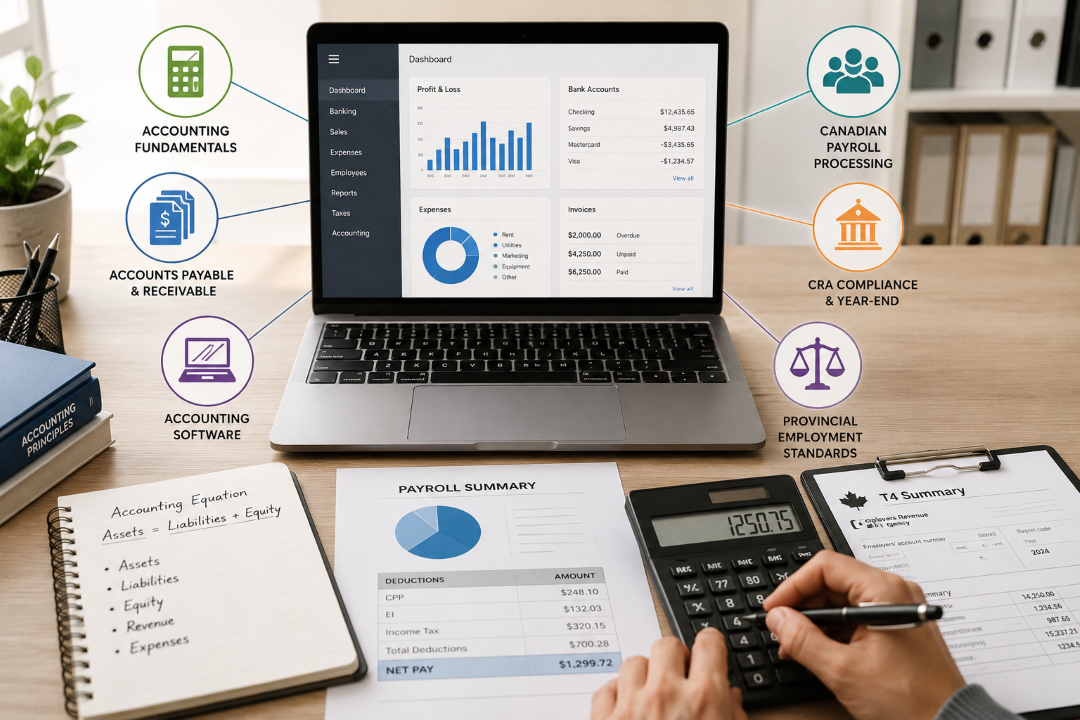
What a Comprehensive Accounting and Payroll Course Covers
A well-structured Accounting and Payroll Course in Canada at IIBS College covers
accounting fundamentals, payroll calculations, Canadian compliance requirements,
employment standards and practical accounting software.
Accounting Fundamentals
- The accounting equation and double-entry bookkeeping
- Assets, liabilities, equity, revenue and expenses
- Journal entries and the general ledger
- Trial balance preparation and error correction
- Balance sheets, income statements and cash flow statements
- Bank reconciliation procedures
Accounts Payable and Accounts Receivable
- Vendor invoice processing and approval workflows
- Payment processing and aging reports
- Customer invoicing and collections management
- Credit-control procedures
Canadian Payroll Processing
- Full-time, part-time, contract and casual employment types
- Salary, hourly, overtime, commission and tip calculations
- CPP, EI and federal and provincial income tax deductions
- Net-pay calculations and direct-deposit processing
- Weekly, bi-weekly, semi-monthly and monthly payroll periods
- Employer CPP contributions, EI premiums and Employer Health Tax
CRA Compliance and Year-End
- Source deductions and employer remittance schedules
- T4 slip preparation, boxes, amounts and codes
- T4A preparation for contractors and self-employed workers
- Record of Employment issuance
- PD7A reconciliation
- Year-end employer summaries
Accounting Software
- QuickBooks Online setup
- Chart-of-accounts configuration
- Transaction entry and financial reporting
- Employee and payroll-module setup
- Pay schedules and payroll tax tables
- Year-end T4 processing and filing
Provincial Employment Standards With an Ontario Focus
- Minimum wage and hours-of-work requirements
- Overtime thresholds and overtime pay rates
- Vacation pay calculations and payout requirements
- Public holiday entitlement and holiday pay
- Substitute holiday rules
- Parental, compassionate care, sick and bereavement leaves
Salary Expectations for Accounting and Payroll Professionals in Canada in 2026
The following salary ranges are based on the figures presented in the Robert Half 2026
Canada Salary Guide and related Canadian market data.
| Role | Salary Range in CAD per Year |
|---|---|
| Accounting or Payroll Administrator — Entry Level | $42,000–$58,000 |
| Payroll Specialist | $52,000–$72,000 |
| Bookkeeper | $48,000–$68,000 |
| Payroll Coordinator | $55,000–$78,000 |
| Senior Payroll Administrator | $65,000–$90,000 |
| Payroll Manager | $85,000–$120,000 |
| Accounting Manager | $80,000–$115,000 |
Payroll manager roles saw a reported 4.1% year-over-year salary increase in 2026,
representing one of the strongest growth rates in the finance and accounting category
cited in the salary guide.
Payroll certifications and relevant Canadian experience may help candidates qualify
for more advanced positions, but salary outcomes vary according to location,
experience, employer, responsibilities and credentials.
The average accountant salary in Canada is often reported at approximately $65,000
annually, with entry-level and senior-level salaries varying considerably by role,
designation, location and experience.
Why Choose IIBS College for Accounting and Payroll Training?
IIBS College’s Accounting and Payroll program is designed around the Canadian market,
including Canadian tax compliance, CRA reporting and payroll legislation that may not
be included in generic international courses.
Canadian-First Curriculum
The training is framed around Canadian requirements, including CRA remittances,
provincial employment standards, CPP and EI calculations and T4 preparation.
Software-Integrated Learning
Students develop practical familiarity with accounting software used by Canadian
employers alongside their theoretical bookkeeping knowledge.
Multiple Learning Formats
Depending on current availability, learners may be able to choose from weekend,
evening and online course-delivery formats with instructor interaction.
Beginner-Inclusive Design
The beginner track starts with accounting fundamentals and is intended for learners
without previous accounting experience.
Career Support
Career-related support may include resume guidance, interview preparation and advice
for applying to accounting and payroll opportunities in Canada.
Registered Career College
IIBS College is registered under the Ontario Career Colleges Act, 2005.
Explore Accounting and Payroll Courses at IIBS
Frequently Asked Questions
Do I need previous education to enrol in an accounting and payroll course?
The beginner-track program starts with accounting fundamentals and does not require
previous accounting knowledge. Admission requirements may vary, so prospective
students should confirm the current requirements directly with IIBS.
How long does an accounting and payroll course take?
Programs may range from approximately four to twelve months depending on the
curriculum, credential, class frequency and whether the format is intensive or
part-time.
Is the online accounting course at IIBS live or self-paced?
IIBS offers instructor-led learning formats. Students should confirm the current
delivery schedule, online format and attendance requirements before enrolling.
Can I pursue the NPI Payroll Compliance Professional designation after the course?
The course may cover payroll knowledge relevant to National Payroll Institute
certification pathways. However, completing an IIBS course does not automatically
grant an NPI designation.
Students must independently satisfy the National Payroll Institute’s current education,
examination, membership and experience requirements.
Is accounting a good career option for newcomers to Canada?
Accounting and payroll skills are used across many Canadian industries. Internationally
trained professionals may benefit from learning Canadian payroll legislation, CRA
requirements, employment standards and commonly used accounting software.
Do payroll certifications increase earning potential?
Relevant certifications may support access to more advanced payroll opportunities.
However, salaries depend on experience, location, employer, responsibilities,
technical skills and professional credentials.
Which accounting software is important for Canadian employers?
QuickBooks is widely used by Canadian small and medium-sized businesses. Sage 50 is
also used in many SME and non-profit environments, while ADP Workforce Now and
Dayforce are used by many larger employers.
Choose Your Course. Build Your Career. Start Today.
Accounting and payroll skills are used across almost every Canadian industry. The
professionals who are best prepared for employment are generally those who combine
proper training with Canadian regulatory knowledge, practical software skills and
relevant workplace experience.
IIBS College’s Accounting and Payroll Course is designed to provide that combination
in a learning format that can accommodate beginners, career switchers and working
professionals.
Enrol in an Accounting and Payroll Course at IIBS
Talk to an Advisor:
Discuss your background, career goals and the course format that may be appropriate
for your schedule.
The right accounting course doesn’t just teach you accounting. It helps you begin
building a Canadian career.