



- 18 Aug, 2026
- 0 Comments
- 18 Mins Read

Manual Testing or Automation First? A Beginner’s QA Learning Path in Toronto
Software quality is important to almost every digital product people use today. Banking platforms, e-commerce websites, mobile apps, healthcare systems, cloud applications, and enterprise software all need to perform reliably before users can depend on them.
That is where software testing and quality assurance professionals play an important role.
For someone exploring QA as a new career path, however, there is often an immediate question:
Should I start with manual testing or go directly into automation testing?
Automation may sound more advanced and technical, but starting with automation tools before understanding how testing actually works can make learning unnecessarily difficult.
For most beginners, a more practical sequence is:
Testing fundamentals → Manual testing → Technical testing → Automation → CI/CD awareness
Manual testing teaches you how to analyze requirements, identify risks, create useful test scenarios, investigate unexpected behaviour, and communicate defects. Automation then allows you to apply those same testing principles more efficiently to suitable repeatable scenarios.
If you are researching a Software Testing Course Toronto learners can use to build practical QA skills, understanding this learning sequence can help you evaluate training options more effectively.
IIBS offers a Software Testing & Quality Assurance course for learners interested in developing knowledge of software quality assurance and modern testing practices.
What Does a Software Tester Actually Do?
Software testing involves checking whether an application, system, or feature performs according to its intended requirements.
But testing is more than opening an application and looking for obvious errors.
Imagine an online shopping website.
A customer expects to be able to:
- create an account;
- log in securely;
- search for products;
- add items to a shopping cart;
- enter shipping information;
- complete payment; and
- receive confirmation.
A tester needs to think beyond whether these actions work once.
What happens if someone enters incorrect information?
What if the same email address is registered twice?
What happens if a payment fails?
What happens when an item becomes unavailable after being added to the cart?
Does the system provide a useful error message?
Does an existing feature continue working after developers release an update?
Good software testing involves examining these possibilities systematically and communicating potential problems before they affect users.
That thinking process is why learning testing fundamentals matters before becoming too focused on individual tools.
What Is Manual Testing?
Manual testing is testing performed directly by a person without depending entirely on automated scripts to execute the test.
Suppose you are testing a new login feature.
You might manually check:
- a correct username and password;
- an incorrect password;
- a blank password;
- an invalid email format;
- an account that does not exist;
- multiple failed login attempts;
- password visibility controls;
- error messages; and
- what happens after successful login.
The value does not come simply from clicking buttons.
The tester is continually asking:
What is supposed to happen?
What else could the user do?
What could fail?
What business rule applies here?
What risk would this problem create?
This analytical approach is often called the testing mindset, and developing it is one of the biggest advantages of beginning with manual QA.
For learners searching for QA training for beginners, building this mindset is generally more valuable initially than memorizing automation syntax.
What Is Automation Testing?
Automation testing uses scripts, frameworks, and specialized tools to execute selected testing activities automatically.
Consider a website that needs the same 200 regression checks every time a new software release is prepared.
Executing all 200 tests manually every few days could consume considerable time.
If appropriate scenarios are automated, a testing framework can repeat those checks consistently and report whether expected results were achieved.
Automation can be particularly valuable for:
- repetitive regression tests;
- frequently executed workflows;
- data-driven testing;
- repeated browser checks;
- API validations;
- stable application functionality; and
- tests incorporated into continuous integration processes.
But automation still depends on human decisions.
The automation framework does not independently understand which business scenarios matter most.
Someone still needs to decide:
- what should be tested;
- what result should be expected;
- which scenario is important;
- whether automation is appropriate;
- what constitutes failure; and
- whether the automated test itself is valid.
That is why automation works best when it is built on strong testing fundamentals.
Manual Testing vs Automation Testing: A Simple Comparison
Manual and automated testing solve different problems.
Manual testing is especially useful when human observation, exploration, judgment, changing requirements, or usability evaluation matters.
Automation testing becomes particularly useful when stable tests need to be performed repeatedly and consistently.
For example, imagine a development team has just introduced a completely new checkout experience.
During the first few weeks, designers and developers may change the workflow repeatedly.
Automating everything immediately could result in scripts constantly breaking because the application itself is still changing.
Manual exploratory testing may be more efficient at that stage.
Once the checkout process becomes stable and needs to be validated during every future release, selected scenarios may become strong candidates for automation.
This is why professional QA teams rarely view the question as:
Manual OR automation?
A better question is:
Where does manual testing provide the most value, and where can automation improve efficiency?
Why Manual Testing Is Usually the Better Starting Point
Automation frameworks can teach you how to instruct software to perform actions.
Manual testing teaches you why those actions should be tested in the first place.
Before building meaningful automated tests, a beginner should understand concepts such as:
- test scenarios;
- test cases;
- expected results;
- actual results;
- positive and negative testing;
- functional testing;
- regression testing;
- integration testing;
- exploratory testing;
- defect lifecycle;
- severity and priority;
- requirements;
- SDLC; and
- STLC.
Without this knowledge, someone may successfully create an automation script that clicks a button but still fail to recognize whether the scenario being automated is useful.
A structured Software Testing & Quality Assurance course can help beginners build broader QA knowledge rather than focusing only on an individual tool.
Manual Testing Teaches You to Think Beyond the Happy Path
One of the biggest differences between beginners and experienced testers is how they approach a requirement.
Consider this simple requirement:
“Users should be able to create an account using their email address and a password.”
A basic test could be:
Enter a valid email and password and confirm that the account is created.
But that is only the happy path.
A tester may also consider:
- What happens when the email already exists?
- Is an invalid email format accepted?
- What is the minimum password length?
- Is there a maximum password length?
- Are spaces accepted?
- What happens if fields are empty?
- What characters are allowed?
- Can the form accidentally be submitted twice?
- Is a confirmation email sent correctly?
- What happens when the connection is interrupted?
- Are error messages understandable?
- Can users correct their information and continue?
These questions require reasoning rather than automation syntax.
Once you develop this habit of thinking, you can decide which scenarios should later become automated tests.
Test Case Design Should Come Before Test Automation
Test-case creation is one of the most useful skills for a beginner to practice.
A test case usually identifies:
- what is being tested;
- any required conditions;
- the steps to perform;
- test data; and
- the expected outcome.
Consider an online store.
One test case may confirm that an available item can be added to the shopping cart.
Another may test what happens when the available quantity is zero.
Another could check whether changing the product quantity correctly updates the total.
Another may confirm that removing the product updates the cart.
Before automating any of these scenarios, someone must identify and design them.
That leads to an important principle:
Automation executes tests. It does not replace thoughtful test design.
Beginners Also Need to Learn Defect Reporting
Finding a software problem is useful only when you can explain it clearly enough for someone else to investigate.
Suppose you tell a developer:
“The checkout page is broken.”
That provides very little information.
A better defect report helps explain:
- the feature affected;
- the environment;
- steps required to reproduce the issue;
- input or test data used;
- expected behaviour;
- actual behaviour;
- evidence such as screenshots where appropriate;
- severity; and
- other relevant observations.
Clear defect reporting helps testers work effectively with developers, business analysts, product managers, project managers, and other team members.
This communication skill remains valuable whether you eventually work primarily with manual testing, automation, APIs, mobile applications, or enterprise systems.
When Is Manual Testing the Better Choice?
Not every test should be automated.
Exploratory Testing
Exploratory testing involves learning about an application while testing it.
The tester uses observations from one action to decide what to investigate next.
This flexibility is difficult to reproduce using a predetermined automation script.
Frequently Changing Features
When requirements and interfaces change constantly, automated scripts may require repeated maintenance.
Manual testing can sometimes be more efficient until the functionality becomes stable.
Usability Evaluation
An automation tool may verify that a button exists and that clicking it triggers an expected event.
A person can notice that the button is confusing, difficult to locate, or poorly labelled.
Unusual or Unexpected Behaviour
Humans can investigate behaviour that was not anticipated when the original test scripts were created.
This remains an important advantage of manual testing.
When Should Beginners Start Learning Automation?
Once you understand how to design and execute tests manually, automation becomes easier to place in context.
A good time to begin automation is when you understand:
- why a particular test exists;
- what result you expect;
- which conditions need to be checked;
- what makes the test fail;
- how the test relates to a requirement; and
- whether the scenario is sufficiently stable and repeatable.
At this stage, learning an automation framework becomes more meaningful because you are using technology to solve a testing problem instead of simply learning commands.
Regression Testing Is a Good Example
Regression testing verifies that existing functionality continues working after software changes.
Imagine a banking application receives updates every few weeks.
Developers may introduce a new feature without intentionally changing existing account or transaction functionality.
However, software components can be interconnected.
A change in one area can unintentionally create a problem somewhere else.
Teams therefore need to retest important existing functionality.
When these scenarios are stable and repeatable, automation can help execute large regression suites more efficiently.
This is one of the clearest examples of manual testing knowledge leading naturally into automation.
Do Beginners Need Programming Knowledge?
You do not necessarily need an advanced programming background to begin learning software testing.
However, programming or scripting becomes more relevant as you move into automation.
Depending on the technologies being used, useful programming concepts may include:
- variables;
- data types;
- conditions;
- loops;
- functions;
- objects;
- error handling; and
- debugging.
The objective for a beginner is not necessarily to become a software developer before becoming a tester.
Instead, develop technical knowledge progressively.
Learn how software behaves.
Learn how to test it.
Then learn enough programming to build and maintain useful automated tests.
This approach can be less overwhelming for students entering QA without a computer science background.
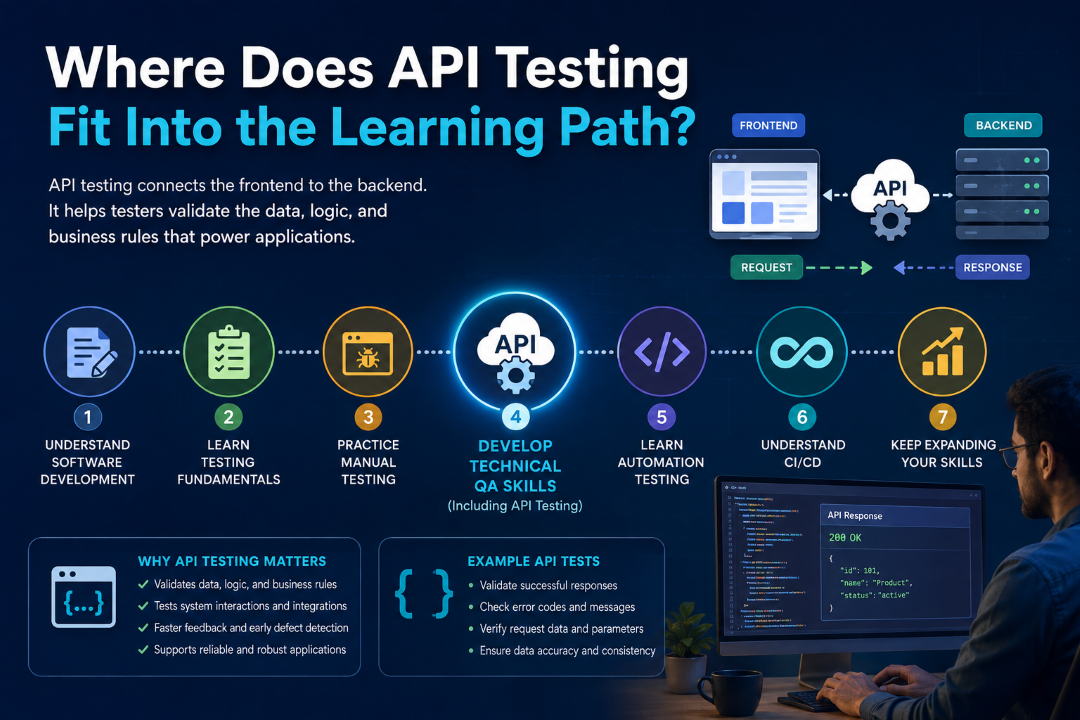
Where Does API Testing Fit Into the Learning Path?
Many modern applications depend on APIs.
A visible application screen may only represent one layer of a much larger system.
For example, when someone searches for an item in an application, the interface may request information from another system through an API.
API testing allows QA professionals to examine how systems exchange requests, responses, and data.
A tester might verify whether:
- valid information returns the correct response;
- required information is missing;
- invalid data is rejected correctly;
- appropriate error codes are returned;
- data values are accurate; and
- business rules are followed.
API testing therefore adds another dimension to a tester’s technical skills.
For beginners, however, it should be viewed as part of a broader progression rather than something that makes manual testing unnecessary.
Why Modern QA Learners Should Understand CI/CD
Software development has moved toward faster and more frequent delivery cycles.
That means testing increasingly needs to happen throughout development rather than being treated only as an activity performed immediately before release.
CI/CD practices can allow selected automated tests to run when developers introduce software changes.
This helps teams receive feedback earlier.
A QA professional does not need to become a DevOps engineer simply to understand testing.
However, understanding where testing fits into modern development and delivery workflows can help testers work more effectively with developers and technical teams.
Is Manual Testing Going Away Because of Automation?
Manual testing is changing, but it is not disappearing.
What is changing is the range of skills expected from QA professionals.
A tester who only knows how to follow a predefined checklist may have fewer options than someone who can combine:
Manual testing + analytical thinking + API knowledge + automation awareness + technical understanding + communication skills
Automation can reduce repetitive testing effort, but it does not eliminate the need for people who understand requirements, user behaviour, risk, business processes, and software quality.
Manual testing should therefore be considered a foundation, rather than the only skill a tester will ever need.
What About AI in Software Testing?
Artificial intelligence is also beginning to influence software testing workflows.
AI-assisted tools can support activities such as:
- generating possible test ideas;
- analyzing requirements;
- suggesting scenarios;
- assisting documentation;
- supporting automation development; and
- analyzing testing information.
But generated output still needs review.
An AI system may suggest a technically reasonable test scenario while missing an important business rule or incorrectly interpreting a requirement.
That makes QA fundamentals even more relevant.
Someone who understands test design can evaluate whether an AI-generated test is actually useful.
Someone who does not understand testing may simply accept the output because it looks convincing.
For beginners, the principle remains the same:
Learn how testing works first. Then use technology to improve how you perform it.
Should You Learn Selenium First?
Beginners often start researching QA and immediately encounter tool names such as Selenium.
Learning a testing tool can certainly become useful.
But selecting a particular technology should not become the first objective.
Testing frameworks evolve.
Organizations use different technology stacks.
New tools emerge.
Testing principles are much more transferable.
If you understand regression testing, you can apply the principle regardless of the automation framework.
If you understand test-case design, you can create useful scenarios using different tools.
If you understand software risk, you can contribute even when joining an organization whose testing environment is unfamiliar.
So instead of asking:
“Which automation tool should I memorize first?”
Ask:
“What testing knowledge will help me work effectively regardless of the tool?”
A Practical QA Learning Path for Beginners
A beginner-friendly progression can look like this:
Stage 1: Understand Software Development
Learn how requirements become software features and how developers, analysts, testers, product teams, and other stakeholders work together.
Stage 2: Learn Testing Fundamentals
Understand functional testing, regression testing, integration testing, exploratory testing, test levels, defects, risks, and quality concepts.
Stage 3: Practice Manual Testing
Test realistic applications, create scenarios, write test cases, document results, and report defects.
Stage 4: Develop Technical QA Skills
Begin exploring databases, APIs, browser tools, and basic programming concepts.
Stage 5: Learn Automation
Understand how appropriate repeatable tests can be automated using relevant frameworks.
Stage 6: Understand CI/CD
Learn how testing can become part of a wider continuous software delivery process.
Stage 7: Keep Expanding Your Skills
QA continues to evolve, so develop familiarity with emerging technologies, new testing practices, and AI-assisted workflows.
This learning order provides context for each new skill instead of turning QA education into a collection of unrelated tools.
What Should You Look for in QA Testing Training in Toronto, Canada?
When comparing QA testing training Toronto Canada learners should look beyond course titles and marketing claims.
Consider whether the training helps you answer practical questions such as:
- Can I understand a requirement?
- Can I identify useful test scenarios?
- Can I write a clear test case?
- Can I recognize positive and negative conditions?
- Can I investigate unexpected behaviour?
- Can I document a defect properly?
- Do I understand where automation is appropriate?
- Can I explain how API testing fits into QA?
- Do I understand how testing relates to the overall software lifecycle?
The goal should be practical understanding rather than simply memorizing definitions.
Learners interested in structured training can review the IIBS Software Testing & Quality Assurance course and compare the curriculum with their learning and career goals.
What About Software Testing Certification?
A software testing certification can be useful for organizing your understanding of established QA terminology, processes, and concepts.
However, certification and practical ability are not the same thing.
Knowing the definition of regression testing does not automatically mean you can identify a useful regression scenario.
Knowing defect terminology does not automatically mean you can create a strong defect report.
Knowing automation terminology does not automatically mean you can identify which tests should be automated.
Certification can therefore support a QA learning journey, but practical testing experience should remain an important part of skill development.
Can You Learn Through a Software Testing Course Online?
For learners balancing work, family responsibilities, or other commitments, a software testing course online can provide a flexible way to develop QA knowledge.
However, the delivery format should not be your only consideration.
Whether training is online or classroom-based, look for opportunities to apply concepts.
Testing is a practical discipline.
Simply watching presentations about testing is different from actually examining an application, creating scenarios, documenting expected behaviour, identifying problems, and deciding which tests could eventually be automated.
Practical application helps turn terminology into usable knowledge.
QA Training for Beginners Without an IT Background
A technology background can be helpful, but it is not the only background that can support QA learning.
People entering software testing may bring transferable skills from many areas.
Someone from accounting may already be comfortable checking accuracy and identifying inconsistencies.
A customer-service professional may understand user frustrations and common customer behaviour.
A business analyst may already have experience understanding requirements.
An operations professional may be good at identifying process failures.
Someone from administration may already have strong documentation skills.
What career changers need is a structured way to connect those existing strengths with software testing practices.
Good QA training for beginners should therefore help learners understand the field progressively rather than assuming everyone already knows software development.
Skills to Develop Alongside Technical Testing
Testing tools matter, but several broader skills can make someone more effective in QA.
Analytical Thinking
You need to understand how different conditions, inputs, requirements, and system components relate to one another.
Attention to Detail
Small inconsistencies may indicate bigger application problems.
Communication
You need to explain defects and risks clearly to people with different technical backgrounds.
Curiosity
Strong testers continually ask what else could happen.
Documentation
Testing activities need to be understandable and reproducible.
Problem Solving
Unexpected behaviour often requires structured investigation.
Adaptability
Testing tools and development practices continue to change.
Developing these abilities alongside technical skills can produce a more balanced QA profile.
Manual Testing or Automation: Which Is Better for Your Career?
Neither skill should be viewed in isolation.
Manual testing helps you understand software quality.
Automation helps you efficiently repeat suitable tests.
API testing helps you investigate services and data exchange.
Technical knowledge helps you understand how applications work.
CI/CD awareness helps you see where testing fits within modern software delivery.
Communication skills help you work with the wider development team.
The strongest career path is therefore not:
Manual Testing vs Automation Testing
It is:
Manual Testing + Automation + Technical QA Knowledge + Continuous Learning
You do not need to master all of these immediately.
Build them in the right order.
How Beginners Can Practice Software Testing
You can begin developing a testing mindset even with a relatively simple application.
Take an online registration form and examine it carefully.
Ask yourself:
- What fields are mandatory?
- What values should be accepted?
- What values should be rejected?
- What happens when information is missing?
- What happens when invalid information is entered?
- Are error messages clear?
- Can the same information be submitted twice?
- What happens when you correct an error?
- What would a real user potentially do unexpectedly?
Write these ideas as test scenarios.
Then turn several scenarios into structured test cases.
Record expected results.
Execute the tests.
Document any unexpected behaviour.
Finally, ask:
Which of these tests would make sense to automate if I needed to repeat them every day?
That one exercise demonstrates the relationship between manual and automation testing surprisingly well.
Choosing a Software Testing Course in Toronto
When evaluating a Software Testing Course in Toronto, focus on the skills you will develop rather than simply the number of tools listed on the course page.
Ask whether the learning path builds fundamentals before advanced topics.
A beginner should ideally understand why testing is performed before concentrating on how an automation framework executes it.
Look for training that helps develop understanding of:
- software testing principles;
- manual testing;
- test-case development;
- defect management;
- practical testing situations;
- technical testing concepts;
- automation concepts; and
- modern software development practices.
The Software Testing & Quality Assurance course at IIBS can be reviewed by learners considering structured QA training and looking to understand how testing knowledge can be developed progressively.
Final Answer: Manual Testing or Automation First?
For most complete beginners, manual testing fundamentals should come first.
That does not mean you should build a career around manual testing alone.
Manual testing gives you the foundation required to understand:
- requirements;
- test scenarios;
- expected behaviour;
- application risk;
- defect reporting;
- regression testing;
- exploratory testing; and
- test design.
Once those concepts make sense, automation becomes much easier to understand.
Instead of simply learning how to make a testing framework click buttons, enter data, or verify text, you understand why the test exists and whether it provides value.
A practical learning sequence is:
Testing Fundamentals → Manual Testing → API & Technical Skills → Automation Testing → CI/CD Awareness → Continuous Learning
For learners considering QA testing training in Toronto, Canada, the most useful question is therefore not whether manual or automation testing is better.
The better question is:
Which learning path will help me understand software quality first and then build the technical skills needed to test modern applications?
Explore the IIBS Software Testing & Quality Assurance course to learn more about structured software testing training.
The goal should not be to memorize one automation tool.
The goal should be to develop the analytical, practical, and technical skills needed to understand what should be tested, why it matters, and how modern QA technologies can support that process.