


- 31 Jul, 2026
- 0 Comments
- 14 Mins Read

AI Certification vs. AI Foundation Training: Which Should You Choose at Each Career Stage?
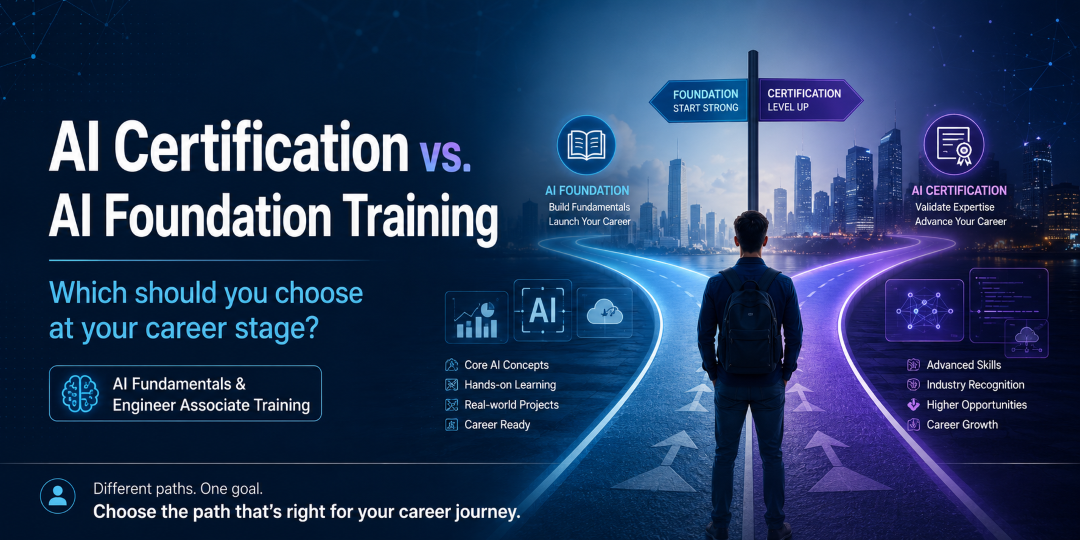
Choosing between AI Foundation Training and an AI Certification can be confusing. Both can support an artificial intelligence career, but they serve different purposes.
Foundation training helps you understand how artificial intelligence works and how to apply it. Certification validates your knowledge against a defined exam standard. For many learners, the most effective path is not choosing one instead of the other. It is completing them in the right order.
Your starting point matters more than your eventual job title. A business professional learning AI for the first time needs a different pathway from a developer preparing to deploy machine learning models.
This guide explains how AI Fundamentals and Engineer Associate Training fits different career stages, including business professionals, developers, data analysts and people interested in AI evaluation roles.
Should You Complete AI Foundation Training or Certification First?
In most cases, you should build practical understanding before preparing for a certification exam.
Certification preparation can teach you the terminology, services and concepts covered in an exam. However, concentrating only on exam questions may not teach you how to choose an appropriate AI tool, evaluate model output or apply AI safely in a workplace.
AI Foundation Training develops the underlying capability. It helps learners understand:
- What artificial intelligence and machine learning can do
- How different types of AI systems work
- How training data affects model performance
- Why models produce inaccurate or biased results
- How AI tools can be applied to business and technical problems
- How to evaluate whether an AI output is reliable
Certification then provides formal evidence that you understand a defined technology platform or body of knowledge.
A practical sequence is therefore:
Foundation knowledge → Hands-on practice → Portfolio project → Certification preparation
Someone who already has relevant technical experience may move through the foundation stage quickly. A complete beginner will generally benefit from spending more time building the fundamentals before attempting an exam.
What Do Foundation Training, Certification and Engineer Associate Mean?
These terms are often used interchangeably, even though they describe different forms of learning.
AI Foundation Training: AI foundation or fundamentals training builds baseline knowledge of artificial intelligence, machine learning, generative AI, responsible AI and practical AI tools. It may be designed for either non-technical professionals or learners preparing for more technical study.
AI Essentials Course: An AI essentials course usually focuses on practical AI literacy. It may cover workplace use cases, prompt design, output verification, privacy, responsible use and the limitations of generative AI without requiring extensive programming.
AI Certification: An AI certification is a credential awarded after a learner passes an examination or completes a formal assessment. Certifications are commonly offered by technology vendors such as AWS and Microsoft. They usually validate knowledge of a particular platform, role or collection of services.
AI Engineer Associate Training: This pathway adds technical implementation skills to foundational knowledge. Learners may study cloud AI services, machine learning workflows, model deployment, APIs, monitoring, security and the integration of AI into applications.
AI Evaluation Engineer Training: AI evaluation training focuses on testing AI systems for quality, safety, fairness, reliability and business suitability. It can include test-set design, model metrics, human review, red-team testing, bias analysis, output monitoring and governance documentation.
A foundation program develops understanding. An engineer associate pathway develops implementation skills. A certification validates a defined set of competencies.
Which AI Learning Path Fits Your Career Stage?
The right pathway depends on your current background, not simply the job title you eventually want.
Business professional with no technical background
A business professional should usually begin with an AI essentials or foundation course.
The objective is not to become a machine learning engineer immediately. It is to understand AI well enough to identify relevant use cases, work effectively with technical teams, evaluate AI-generated information and use AI tools responsibly.
A suitable pathway may be:
- Complete an AI Essentials or AI Foundation Training program.
- Apply AI tools to a real workplace process.
- Create a small project or use-case presentation.
- Prepare for a current foundational certification when a formal credential supports your role.
This pathway may be relevant to professionals working in operations, finance, marketing, human resources, project management, customer service or business analysis.
Avoid beginning with memorization-based certification preparation when you do not yet understand the underlying concepts. Passing an exam is useful, but practical understanding is what allows you to apply the knowledge after the exam.
IT professional or developer moving into AI
Developers and IT professionals already have valuable technical experience, but software development skills do not automatically cover machine learning concepts.
A technical learner may need structured instruction in:
- Supervised and unsupervised learning
- Training, validation and test data
- Feature engineering
- Model selection
- Evaluation metrics
- Generative AI application architecture
- Cloud-based AI services
- Deployment and model monitoring
A suitable pathway may include AI Fundamentals and Engineer Associate Training followed by a current vendor certification and a portfolio of applied projects.
For AWS-focused learners, current options include AWS Certified AI Practitioner and AWS Certified Machine Learning Engineer – Associate.
The former AWS Certified Machine Learning – Specialty exam retired on March 31, 2026, so new learners should not build their 2026 training plan around that retired examination.
Data analyst adding artificial intelligence and machine learning skills
Data analysts often enter AI with a useful combination of statistical thinking, data preparation, visualization and business communication skills.
The next step is usually to learn how machine learning differs from descriptive reporting. Important topics include:
- Classification and regression
- Clustering
- Model training and validation
- Feature selection
- Hyperparameter tuning
- Overfitting and underfitting
- Model interpretation
- Production deployment
- Performance monitoring
A data analyst can begin with applied AI fundamentals, build machine learning projects using familiar datasets and then pursue a technical certification when it supports their employment goals.
Projects are particularly important for this profile. A portfolio can demonstrate that the learner can move from data preparation to model evaluation and business interpretation rather than only completing an exam.
Professional interested in AI evaluation and governance
AI evaluation is an emerging specialization for people who want to assess whether AI systems perform safely and reliably.
An AI evaluation professional may help an organization:
- Define success criteria for an AI system
- Build representative evaluation datasets
- Test accuracy and consistency
- Review hallucinations and unsupported outputs
- Identify bias or uneven performance
- Conduct adversarial and edge-case testing
- Monitor model drift
- Maintain evaluation records
- Recommend human review controls
This pathway may suit quality assurance professionals, business analysts, data analysts, risk professionals, compliance specialists and technically oriented testers.
Learners should begin with AI and machine learning fundamentals before specializing in evaluation methods. They may then study explainability tools, responsible AI frameworks, automated evaluation pipelines and human-review processes.
There is not yet one universally dominant certification specifically for the title “AI Evaluation Engineer.” Employers may instead look for a combination of AI knowledge, testing experience, governance awareness and practical evaluation projects.
What Should Comprehensive AI Foundation Training Cover?
A strong AI fundamentals course should build more than familiarity with popular AI tools. It should teach learners how AI systems work, where they fail and how to evaluate them.
Understanding artificial intelligence in 2026: Learners should understand the relationship between artificial intelligence, machine learning, deep learning, generative AI and agentic systems. They should also understand the difference between a general-purpose AI model and a system configured for a particular business process.
Machine learning concepts: Training should explain classification, regression, clustering, neural networks and reinforcement learning in accessible language. Learners should understand training data, features, labels, loss functions, optimization and the difference between training and inference.
Generative AI and large language models: Learners should explore how large language models generate responses, why prompt design matters, why hallucinations occur and why model output must be verified before it is used in important decisions.
The curriculum should also distinguish between prompting, retrieval-augmented generation, fine-tuning, tool use and AI agents. These approaches solve different problems and involve different levels of technical complexity.
AI evaluation fundamentals: Learners should understand common metrics such as accuracy, precision, recall and F1 score.
They should also understand that generative AI evaluation may require several forms of assessment, including factuality checks, groundedness, relevance, safety testing and human review. No single metric can fully determine whether a generative AI system is suitable for a business use case.
Responsible AI and governance: Foundation training should introduce fairness, accountability, transparency, privacy, security and human oversight.
The original Artificial Intelligence and Data Act was proposed as part of Bill C-27 but did not become law. Learners in Canada should therefore study the country’s evolving AI policy environment, existing privacy obligations and the governance controls organizations are adopting while federal AI legislation continues to develop.
AI tools and practical applications: Learners should explore model interfaces, AI APIs, no-code tools, cloud AI platforms and enterprise AI applications. The purpose is not to memorize every available product. It is to understand how to choose a tool based on the problem, data, risk level and expected outcome.
Applied AI project: A practical project allows learners to demonstrate that they can define a problem, select a tool, test the output, identify limitations and communicate the result.
A portfolio-ready project may be more valuable to an employer than a list of tools without evidence of how the learner used them.
What Does the AI Engineer Associate Path Add?
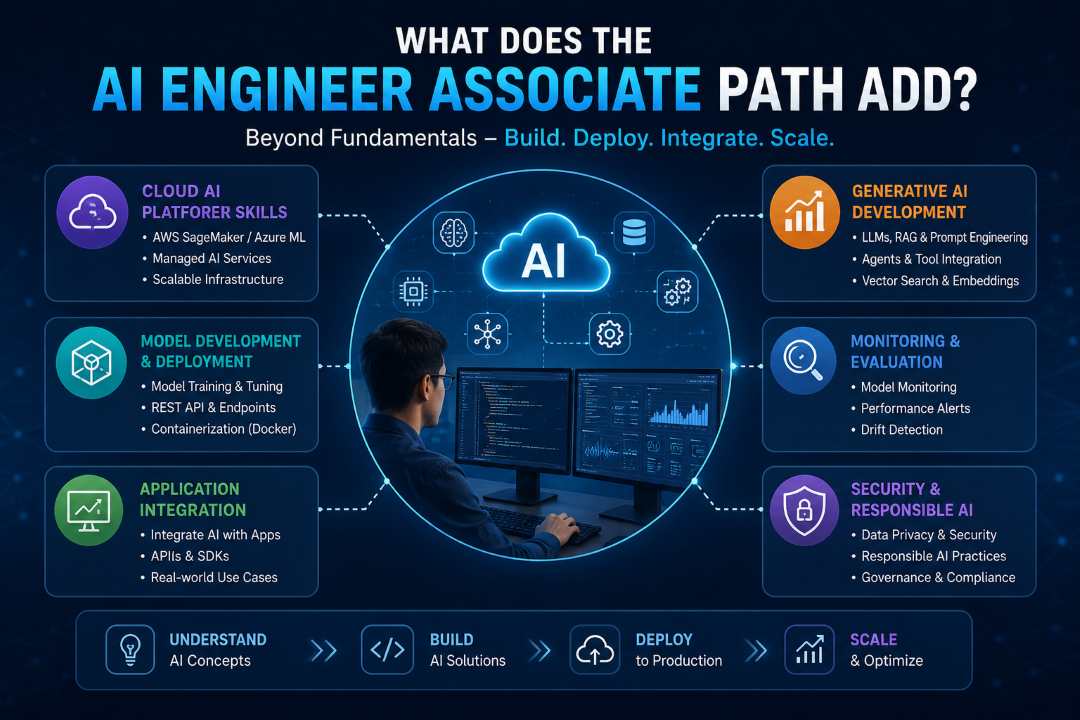
Engineer associate training goes beyond conceptual understanding and teaches learners how AI systems are developed, integrated and managed.
Cloud AI platform skills: Learners may work with Microsoft Azure or AWS services for data preparation, model development, generative AI applications, deployment and monitoring.
Model development and deployment: Technical training can include model selection, experiment tracking, version control, API development, containerization and production deployment.
Application integration: Learners may use REST APIs or software development kits to connect AI services with websites, internal applications, databases and business workflows.
Generative AI development: A current engineer pathway should cover retrieval-augmented generation, vector search, prompt orchestration, agents, tool integration, content filtering and evaluation.
Monitoring and evaluation: Deployment is not the end of an AI project. Learners should understand how to monitor latency, errors, cost, data quality, model drift and output performance after release.
Security and responsible deployment: Technical programs should address access control, secure data handling, prompt injection, sensitive information exposure and the use of human approval for high-impact actions.
Which AI Certifications Are Current in 2026?
Certification portfolios change frequently. Learners should always check the official vendor page before paying for an exam or beginning a certification-preparation program.
AWS Certified AI Practitioner: This foundational certification covers artificial intelligence, machine learning, generative AI concepts and relevant AWS services. It is designed for people who need an understanding of AI use cases without necessarily developing machine learning systems.
AWS Certified Machine Learning Engineer – Associate: This technical certification validates skills related to implementing and operationalizing machine learning workloads on AWS. AWS describes the intended candidate as someone with practical machine learning engineering and AWS experience.
Microsoft Azure AI Fundamentals – AI-901: Microsoft retired the previous AI-900 exam on June 30, 2026. Learners pursuing Azure AI Fundamentals should now review the current AI-901 exam objectives.
Microsoft Azure AI Apps and Agents Developer Associate – AI-103: Microsoft also retired AI-102 and the former Azure AI Engineer Associate certification on June 30, 2026. Its current role-based pathway is Azure AI Apps and Agents Developer Associate, which covers the development and deployment of AI applications and agents using Python and Microsoft Foundry.
Certification names and exam objectives can change. Training providers should review their course pages regularly and avoid promising preparation for examinations that vendors have already retired.
AI Foundation Training vs. Engineer Training: Career Outcomes
Training can help develop relevant skills, but completing a course or certification does not guarantee a particular job title or salary. Employment outcomes depend on previous experience, technical ability, portfolio quality, location, industry and employer requirements.
| Learning pathway | Potential applications | What employers may expect |
| AI Essentials or Foundation Training | AI-enabled business operations, business analysis, project support, responsible workplace AI use | Domain knowledge, AI literacy and evidence of practical application |
| Applied AI Fundamentals | Junior analytics projects, AI-assisted data work and transition into technical study | Data skills, basic programming and portfolio projects |
| Engineer Associate Training | AI application development, cloud AI integration, machine learning operations and model deployment | Programming, cloud skills, projects and deployment knowledge |
| AI Evaluation Specialization | AI quality assurance, model testing, responsible AI, risk and governance support | Testing methodology, evaluation design, documentation and AI fundamentals |
| Artificial Intelligence Diploma | Broader preparation in machine learning, data science, NLP, computer vision and AI development | Technical depth, substantial projects and continued practical experience |
For a more reliable salary benchmark, the Government of Canada Job Bank reports that data scientists in Ontario typically earn between $31.25 and $71.79 per hour, with a median wage of $47.69 per hour. Annualized at 40 hours per week, that is approximately $65,000 to $149,000, with a median near $99,000.
These figures cover the broader data scientist occupational category and should not be interpreted as guaranteed starting salaries for new graduates.
Why Consider AI Training at IIBS?
IIBS offers two relevant pathways for learners at different stages.
The AI Fundamentals and Engineer Associate Training program focuses on AI and machine learning concepts using Microsoft Azure. The listed curriculum includes Azure AI services, data preparation, model training, deployment, responsible AI and application integration.
The current course page describes the program as a 10-week, part-time course with online and classroom learning options. Because the page still references the retired AI-900 and AI-102 exams, prospective learners should confirm how the curriculum has been updated for AI-901 and AI-103 before enrolling.
For learners seeking a more extensive technical pathway, the Diploma in Artificial Intelligence covers machine learning, data science, natural language processing, computer vision, AI ethics, Python, R and a capstone project.
The current diploma page lists a 12-month full-time format, an on-campus mode of study and a curriculum progressing from mathematics and programming to machine learning, deep learning, NLP, computer vision and AI governance.
IIBS has also participated in Employment Ontario Skills Development Fund initiatives that offered funded technology training to eligible Ontario residents. Funding is cohort-specific and should not be presented as automatically available to every applicant.
Prospective learners should check current government-funded training availability and confirm residency, employment and program eligibility directly with an advisor.
Frequently Asked Questions
Should I complete AI Foundation Training before certification preparation?
Foundation training should generally come first when you are new to AI. It develops the understanding needed to apply AI concepts rather than simply memorize exam terminology. Learners who already have strong AI experience may use a shorter review before beginning certification preparation.
What is the difference between an AI fundamentals course and an AI certification?
An AI fundamentals course teaches concepts and practical skills. A certification validates a defined set of competencies through an examination or formal assessment. Training is the learning process; certification is the credential.
What is the difference between AI Foundation Training and an Artificial Intelligence Diploma?
Foundation training is usually shorter and focuses on baseline knowledge, practical AI use and preparation for further specialization.
An artificial intelligence diploma is more comprehensive. It may include mathematics, programming, machine learning algorithms, deep learning, natural language processing, computer vision, ethics and a major applied project.
What does an AI Evaluation Engineer do?
An AI Evaluation Engineer or AI evaluation specialist tests AI systems for accuracy, reliability, safety, fairness and consistency. Responsibilities may include designing test datasets, defining evaluation metrics, reviewing failures, conducting human evaluations and monitoring deployed systems.
Because job titles differ between employers, similar work may also appear under responsible AI, model risk, AI quality assurance, machine learning validation or AI governance roles.
Which foundational Microsoft AI exam should learners take in 2026?
Microsoft retired AI-900 on June 30, 2026. Learners beginning the Azure AI Fundamentals pathway should review the current AI-901 exam.
Which Microsoft certification replaced Azure AI Engineer Associate?
Microsoft retired the AI-102 exam and Azure AI Engineer Associate certification on June 30, 2026. The current role-based certification is Azure AI Apps and Agents Developer Associate, associated with exam AI-103.
Is AWS Machine Learning – Specialty still available?
No. AWS retired the Machine Learning – Specialty exam on March 31, 2026. New learners can consider AWS Certified Machine Learning Engineer – Associate, depending on their experience and career goals.
Can business professionals take an AI course without programming experience?
Yes. Business-focused AI essentials and foundation courses can teach AI literacy, use-case selection, prompt design, output evaluation and responsible AI without requiring advanced programming.
Technical engineer training may require basic programming, cloud or IT knowledge.
Can I complete AI training while working full-time?
Part-time, online and classroom options may be available depending on the program and cohort. The IIBS AI Foundation and Engineer Associate page currently lists a 10-week part-time format. Learners should confirm the class schedule before registering.
Is government-funded AI training available in Ontario?
Some eligible Ontario residents may have access to funded training through specific Employment Ontario initiatives or approved cohorts. Funding is not guaranteed, and availability may change.
Applicants should contact IIBS to confirm the current program, eligibility requirements, covered costs and application process.
The Right AI Path Starts with Your Current Skills
The foundation-versus-certification decision does not have one answer for every learner.
A business professional may need AI literacy and responsible workplace application. A developer may need machine learning concepts, cloud AI services and deployment practice. A data analyst may need an applied transition into model development. A quality or governance professional may need specialized AI evaluation skills.
The most effective pathway is usually:
Build the foundation. Apply the knowledge. Create evidence of your skills. Then pursue the certification that supports your career objective.
Explore the AI Fundamentals and Engineer Associate Training program for a shorter Azure-focused pathway.
Explore the Diploma in Artificial Intelligence for broader technical study in machine learning, programming, NLP, computer vision and applied AI projects.
You can also contact an IIBS advisor to discuss your current background, learning goals, upcoming schedules and possible funding options.
Foundation or certification? The right answer begins with understanding where you are today—and choosing a program that helps you build the skills required for your next realistic career step.