


- 31 Jul, 2026
- 0 Comments
- 15 Mins Read

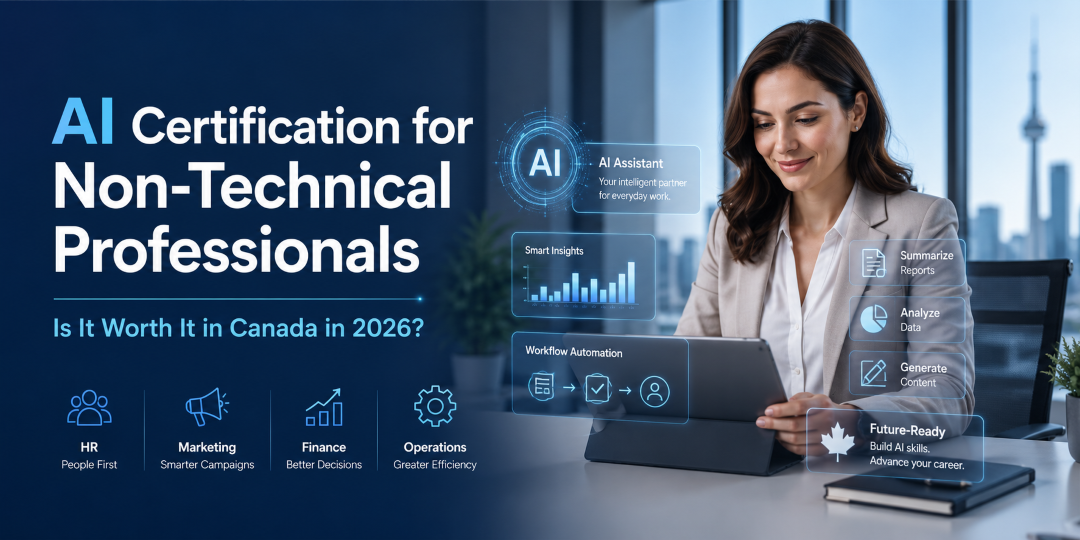
AI Certification for Non-Technical Professionals in Canada: Is It Worth It in 2026?
Artificial intelligence is no longer relevant only to programmers, data scientists and technology companies.
Marketing teams use AI to research audiences and draft campaign content. Human resources professionals use it to summarize policies and improve employee communications. Finance teams use AI-assisted tools to explain data, prepare reports and identify unusual patterns. Project managers use it to organize meeting notes, draft status updates and document workflows.
As a result, many professionals are now asking an important question:
Is taking an AI course in Canada genuinely worth it for someone without a technical background?
The honest answer is yes—but only when the course matches your role, experience and career goals.
A practical AI course can help business professionals become more productive, make better decisions and communicate more confidently about artificial intelligence. However, simply collecting an AI certificate will not automatically lead to a promotion, salary increase or new job.
The real value comes from learning how to apply AI responsibly to real workplace problems.
The Quick Answer: Is AI Certification Worth It?
AI certification can be worth the investment for a non-technical professional when the program helps you:
- Use AI tools in your current job
- Write effective prompts
- Evaluate AI-generated information
- Protect confidential and personal data
- Understand AI risks and limitations
- Build practical examples for your portfolio
- Explain how AI supports business outcomes
- Prepare for a recognized certification
It may not be worth it when a course:
- Focuses heavily on coding that you do not need
- Promises guaranteed employment or salary increases
- Teaches only basic ChatGPT commands
- Provides no practical exercises or projects
- Uses outdated tools and examples
- Awards a certificate without assessing your skills
The certificate itself is supporting evidence. Your ability to demonstrate what you can do with AI is usually more valuable.
Why AI Literacy Matters in Canada in 2026
AI adoption in Canadian workplaces is increasing.
Statistics Canada reported that 19.2% of Canadian businesses used AI to produce goods or deliver services in 2026, an increase of seven percentage points from the previous year. Statistics Canada also reported that, in March 2026, 41.6% of workers had used at least one AI or automation technology in their main job or business.
These numbers do not mean that every Canadian job requires advanced AI expertise. They do show that AI-supported work is becoming more common across industries.
Employers increasingly value professionals who can:
- Use AI tools without exposing confidential information
- Review outputs instead of accepting them blindly
- Recognize bias, inaccuracies and hallucinations
- Select an appropriate tool for a business task
- Explain where human judgment is still required
- Help colleagues adopt AI responsibly
- Measure whether AI is improving productivity or quality
This is the practical meaning of AI literacy in Canada in 2026.
What AI Literacy Means for a Business Professional
AI literacy does not mean becoming a machine learning engineer.
Most non-technical professionals do not need to:
- Build machine learning models
- Train neural networks
- Configure cloud infrastructure
- Study advanced mathematics
- Develop AI applications
- Write production-level Python code
They do need to understand how to use AI effectively and responsibly.
A business professional should be able to:
- Explain the basic difference between AI, machine learning and generative AI
- Understand what AI tools can and cannot do reliably
- Create clear prompts with context, instructions and output requirements
- Verify facts, calculations, quotations and sources
- Protect personal, client and organizational information
- Recognize potential bias in AI-generated recommendations
- Select the right AI tool for a specific task
- Combine AI assistance with professional judgment
- Document how AI contributed to important work
- Communicate business requirements to technical teams
A good AI course for business professionals should develop these capabilities through hands-on activities rather than theory alone.
What Canadian Employers Actually Value
Employers are unlikely to hire someone only because an AI certificate appears on their résumé.
They are more likely to value a candidate who can explain:
- The business problem: What task or process needed improvement?
- The AI application: Which tool was used, and why?
- The human review: How was the output checked?
- The result: Did the process save time, improve quality or reduce repetitive work?
- The risk controls: How were privacy, bias and accuracy considered?
For example, “Completed an AI course” is a weak résumé statement.
A stronger statement would be:
Developed a structured AI-assisted reporting workflow that reduced the time required to prepare weekly project summaries while maintaining human review for accuracy and confidentiality.
The second statement demonstrates application, judgment and measurable value.
How AI Is Affecting Major Business Functions
Marketing and Communications
Marketing professionals use business AI tools for:
- Audience and competitor research
- Content ideation
- Drafting social media posts
- Preparing campaign variations
- Summarizing customer feedback
- Developing content briefs
- Repurposing long-form content
- Creating presentation outlines
- Improving first drafts of emails and reports
Training is valuable because effective AI-assisted marketing requires more than generating text.
Professionals must know how to provide brand context, verify claims, edit generic language, maintain an appropriate tone and avoid publishing inaccurate information.
Human Resources
HR professionals may use AI for:
- Drafting job descriptions
- Preparing interview questions
- Summarizing policies
- Creating onboarding materials
- Drafting employee communications
- Organizing training information
- Analysing anonymized workforce feedback
- Supporting administrative workflows
HR teams must be especially careful when AI affects recruitment, employee evaluation or workplace decisions.
Human oversight is essential because AI-generated recommendations can reflect incomplete data, historical bias or inappropriate assumptions.
Finance and Accounting
Finance professionals may use AI assistance to:
- Explain financial information in plain language
- Draft management commentary
- Summarize lengthy reports
- Organize variance explanations
- Create reporting templates
- Identify questions for further investigation
- Prepare meeting briefings
- Document recurring procedures
AI should not replace professional review, regulatory judgment or approved financial controls.
Numbers, calculations, legal statements and financial recommendations must always be verified using reliable sources and authorized systems.
Operations and Project Management
Operations and project professionals can use AI to:
- Summarize meeting notes
- Draft project updates
- Organize action items
- Create process documentation
- Prepare risk-register drafts
- Identify missing information
- Compare versions of documents
- Draft stakeholder communications
- Turn unstructured notes into organized plans
The greatest value often comes from reducing repetitive documentation so professionals can spend more time on coordination, problem-solving and decision-making.
Sales and Customer Service
Sales and service teams can use AI to:
- Draft personalized outreach
- Summarize account information
- Prepare call notes
- Develop proposal outlines
- Analyse common customer questions
- Draft follow-up messages
- Organize CRM notes
- Create knowledge-base content
Customer and account information should only be used in accordance with organizational policies, privacy requirements and approved AI tools.
AI Certification Options for Non-Technical Professionals
The best certification depends on whether you want workplace productivity skills, cloud-platform knowledge or a deeper technical career pathway.
1. Microsoft Certified: AI Business Professional
Microsoft’s AI Business Professional certification is designed for business users who work with generative AI productivity tools without building AI applications or writing code.
It covers:
- Generative AI fundamentals
- Prompt and conversation management
- Drafting and analysing business content
- Microsoft 365 Copilot workflows
- AI-supported business decision-making
The associated exam is currently identified as AB-730. For professionals working in Microsoft 365 environments, this may be one of the most directly relevant business-focused credentials available in 2026.
2. AWS Certified AI Practitioner
The AWS Certified AI Practitioner, or AIF-C01, validates foundational knowledge of AI, machine learning, generative AI and their business applications.
AWS identifies business analysts, marketing professionals, project managers, product managers, sales professionals and line-of-business managers among the relevant candidate roles.
Candidates are expected to understand AI solutions, but they are not expected to develop AI models, build AI pipelines or perform advanced mathematical analysis.
This credential is a good option for professionals working in—or planning to work with—organizations that use AWS technologies.
3. Google AI Essentials
Google AI Essentials is a beginner-friendly course covering:
- Generative AI fundamentals
- Workplace productivity
- Prompting
- Responsible AI use
- Selecting AI tools for different tasks
Google states that the course requires no previous experience, includes five modules and can generally be completed in under five hours. It is self-paced and provides a certificate after completion.
Google AI Essentials can provide a useful introduction, but professionals may still need deeper, role-specific training to apply the concepts in complex workplace situations.
It is also important to note that the program is not automatically free in Canada. Google currently lists a subscription price of USD $49 per month after a seven-day trial for learners in the United States and Canada, although pricing can change.
4. Microsoft Azure AI Fundamentals
Microsoft Azure AI Fundamentals now uses the AI-901 exam rather than the older AI-900 exam.
The updated pathway is more technical than many general business AI courses. Microsoft states that candidates should have conceptual knowledge of Azure AI solutions, familiarity with Azure resources and foundational Python programming knowledge.
Therefore, AI-901 may be more appropriate for:
- IT professionals
- Technical business analysts
- Junior cloud professionals
- Aspiring AI engineers
- Professionals working closely with Azure technical teams
A purely non-technical professional may find Microsoft AI Business Professional more directly relevant.
5. Institution-Led AI Training
A structured, instructor-led AI course in Canada can provide something that short self-paced certificates often cannot:
- Live explanations
- Instructor feedback
- Canadian workplace examples
- Guided exercises
- Function-specific applications
- Peer discussion
- Responsible-use scenarios
- Practical projects
- Certification pathway guidance
The quality of institution-led programs varies, so learners should carefully examine the curriculum, delivery format, instructor experience and expected outcomes before enrolling.
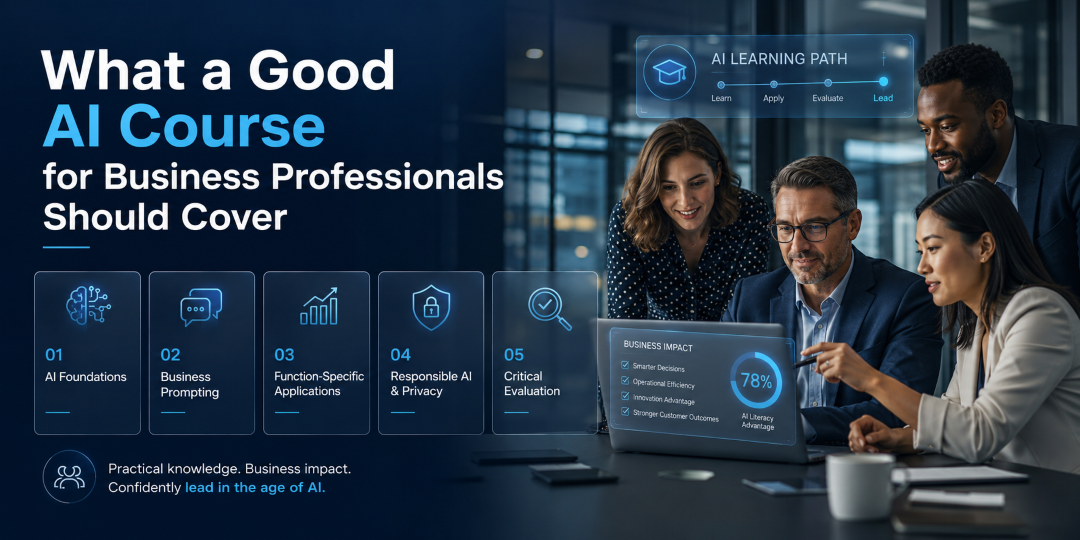
What a Good AI Course for Business Professionals Should Cover
AI Foundations
The course should explain:
- What artificial intelligence is
- How machine learning differs from generative AI
- How large language models work conceptually
- Why AI tools can produce incorrect information
- What AI can do reliably
- Where AI limitations require human judgment
Prompting for Business Tasks
Learners should practise:
- Providing relevant context
- Assigning the AI a specific role
- Defining the audience
- Setting clear constraints
- Requesting a particular format
- Providing examples
- Asking the AI to identify uncertainty
- Refining outputs through follow-up prompts
Prompting should be taught as structured communication—not as a collection of “magic prompts.”
AI-Assisted Research
The course should explain how to:
- Develop research questions
- Organize findings
- Compare alternatives
- Summarize source material
- Separate facts from assumptions
- Verify quotations and statistics
- Avoid relying on fabricated citations
AI can accelerate research, but it should not be treated as the original source of factual information.
Function-Specific Applications
A strong course should provide examples relevant to:
- Marketing
- Human resources
- Finance
- Accounting
- Sales
- Operations
- Project management
- Customer service
- Business analysis
- Administration
Role-specific practice helps learners transfer classroom knowledge into their workplace.
Critical Evaluation
Learners should be trained to check:
- Factual accuracy
- Numerical calculations
- Citations and links
- Legal or regulatory statements
- Bias and unfair assumptions
- Missing context
- Outdated information
- Confidentiality risks
- Whether the output answers the actual question
Critical evaluation may be the most important skill in business AI training.
Responsible AI and Privacy
Canadian organizations that develop or use generative AI remain responsible for complying with applicable privacy laws.
The Office of the Privacy Commissioner of Canada recommends that organizations limit personal information, communicate transparently, evaluate risks, establish accountability and take reasonable steps to verify AI-generated outputs—particularly when outputs affect individuals.
Professionals should learn never to submit confidential, personal or sensitive information to an unapproved public AI tool.
Examples include:
- Customer records
- Employee information
- Health information
- Financial account data
- Confidential contracts
- Proprietary business plans
- Passwords and access credentials
- Unreleased company information
A Correction About AI Regulation in Canada
Some older content still refers to Bill C-27 and the proposed Artificial Intelligence and Data Act as though they became law.
Bill C-27 did not reach report stage or third reading before the 44th Parliament ended on January 6, 2025. In June 2026, the federal government introduced Bill C-36, which proposes a new privacy and consumer-data framework.
For business professionals, the practical lesson is simple:
- Existing privacy laws still apply
- Organizational AI policies must be followed
- AI regulation continues to evolve
- High-impact decisions require careful oversight
- Professionals should not rely on outdated summaries of proposed legislation
A credible AI training program should clearly distinguish between current law, regulatory guidance and proposed legislation.
The Real ROI of AI Training
The return on an AI course should not be measured only by the certificate.
It should be measured by changes in your work.
Possible returns include:
- Faster first drafts
- Better-organized research
- More consistent documentation
- Improved presentation preparation
- Reduced administrative work
- Stronger communication with technical teams
- Greater confidence reviewing AI output
- Better awareness of privacy and risk
- New responsibilities within your organization
- Stronger examples for interviews and performance reviews
Google cites research indicating that 67% of workers who had used generative AI estimated that it saved them at least two hours per week. Individual results will vary by role, tool access, experience and the quality of the workflow.
The important question is not simply, “How much time did AI save?”
It is:
What did you do with the time that was saved?
If that time is redirected toward strategy, client work, problem-solving, analysis or professional development, the value can be significant.
How to Decide Whether an AI Course Is Worth It for You
Before enrolling, ask yourself the following questions.
What problem am I trying to solve?
Examples include:
- I spend too much time writing routine reports
- I want to improve my marketing workflow
- I need to understand AI tools used by my organization
- I want to move into business analysis
- I need to communicate better with technical teams
- I want a recognized cloud AI credential
- I want to move into a technical AI career
Your answer determines the type of training you need.
Will I use the skills immediately?
A course produces better results when learners apply the skills during or shortly after training.
Choose a program that lets you work on tasks related to your actual role.
Does the program include practical work?
Look for:
- Exercises
- Case studies
- Role-specific assignments
- Tool demonstrations
- Feedback
- A final project
- Portfolio-ready examples
Are the outcomes realistic?
Be cautious of claims such as:
- Guaranteed employment
- Guaranteed certification
- Guaranteed salary increases
- Instant AI expertise
- Becoming an AI engineer without technical study
- Mastering AI in a few hours
A credible provider should explain both the value and limitations of the program.
Does the course match my technical level?
This is especially important.
A business AI course may focus on prompting, productivity and responsible use.
A technical AI diploma may include:
- Mathematics
- Statistics
- Python
- Machine learning
- Deep learning
- Natural language processing
- Computer vision
- Data science
- Model development
Neither pathway is automatically better. They serve different learners and career goals.
Which IIBS AI Pathway Is Right for You?
Professionals considering IIBS should carefully distinguish between business-focused AI training and the current Diploma in Artificial Intelligence.
The IIBS Diploma in Artificial Intelligence is a deeper technical program. The current course page lists:
- A 52-week curriculum
- Full-time, on-campus delivery
- Mathematics for AI
- Python and R programming
- Machine learning
- Deep learning and neural networks
- Data science
- Natural language processing
- Computer vision
- AI ethics and governance
- A capstone project
Basic programming knowledge is recommended.
This diploma may be suitable for learners who want to develop technical AI capabilities or explore careers such as:
- AI specialist
- Machine learning engineer
- Data scientist
- NLP specialist
- Computer vision specialist
- Business intelligence developer
However, a professional who only wants a short, no-code program for marketing, HR, finance or operations should confirm whether IIBS currently offers a separate AI Business Essentials for Professionals intake.
Do not assume that a technical AI diploma and a non-technical business AI course have the same curriculum, duration or career outcome.
Explore the Diploma in Artificial Intelligence at IIBS
Frequently Asked Questions
Do I need coding skills to take an AI course in Canada?
Not necessarily.
Business-focused AI courses covering prompting, productivity and responsible AI may require no coding. Technical AI diplomas and engineering certifications may include Python, mathematics, machine learning and cloud technologies.
Always review the actual curriculum before enrolling.
Is an AI certification enough to get a job?
No certification guarantees employment.
A certification can strengthen your résumé, but employers may also evaluate your experience, communication skills, business knowledge, portfolio, problem-solving ability and understanding of responsible AI use.
What is the best AI certification for a non-technical professional?
The best option depends on your workplace.
Microsoft AI Business Professional may suit Microsoft 365 business users. AWS Certified AI Practitioner may suit professionals working around AWS environments. Google AI Essentials may provide an accessible introduction.
Professionals seeking a technical AI career will require more advanced study.
Is Microsoft AI-900 still the current exam?
Microsoft’s current Azure AI Fundamentals pathway uses the AI-901 exam. The updated exam expects more technical knowledge than many general business AI programs, including familiarity with Python and Azure resources.
Is Google AI Essentials free in Canada?
Google currently lists the program at USD $49 per month after a seven-day trial for learners in Canada and the United States. Pricing and promotions may change, so learners should confirm the current cost before enrolling.
Can AI training increase my salary?
AI skills may make a professional more competitive, but completing a course does not guarantee a salary increase.
Salary outcomes depend on the role, industry, location, experience, demonstrated ability and how effectively the learner applies AI to business outcomes.
Is AI training relevant for HR, marketing and finance professionals?
Yes.
These functions already use AI-assisted tools for communication, research, reporting, analysis and workflow support. Professionals must also understand accuracy, confidentiality, bias and human oversight.
How can I demonstrate AI skills to an employer?
Create two or three practical case studies showing:
- The original business problem
- The AI tool or method used
- The prompts or workflow
- How the output was verified
- The risks considered
- The measurable result
Remove confidential information before presenting workplace examples.
Final Verdict: Is AI Certification Worth It in Canada?
AI certification for non-technical professionals can be worth it in Canada in 2026—but the certificate alone is not the main benefit.
The strongest return comes from developing practical AI literacy:
- Knowing how to use AI tools
- Knowing when not to use them
- Protecting confidential information
- Checking outputs carefully
- Applying AI to real business tasks
- Demonstrating measurable results
- Maintaining human accountability
Choose a short business-focused program when your goal is workplace productivity and responsible AI use.
Choose a technical diploma when your goal is to study programming, machine learning, data science and AI development in greater depth.
The right AI course in Canada should match the work you want to perform—not simply the trend you want to follow.
Ready to explore a deeper technical pathway?
Review the Diploma in Artificial Intelligence at IIBS and speak with an advisor about the curriculum, delivery format, prerequisites and career alignment before applying.