


- 22 Apr, 2026
- 0 Comments
- 10 Mins Read

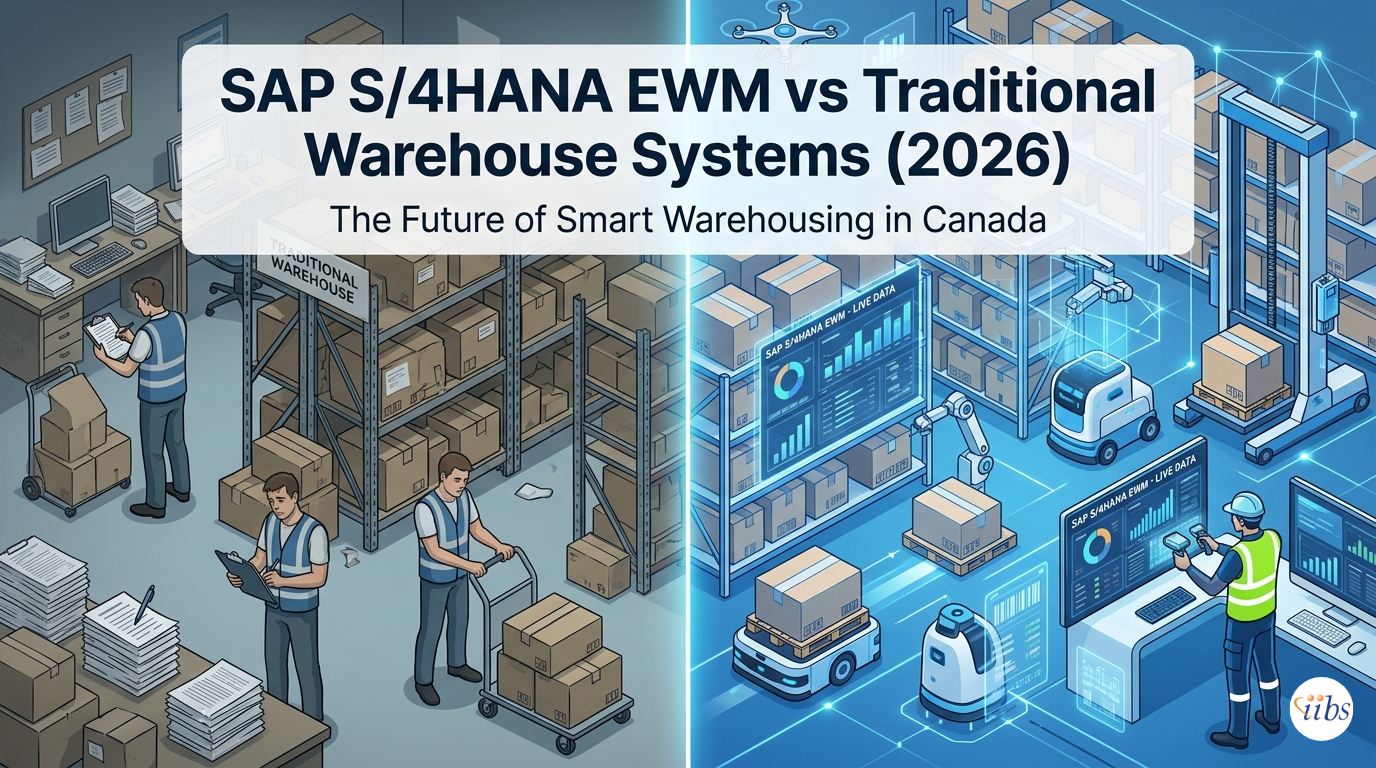
SAP S/4HANA EWM vs Traditional Warehouse Management Systems in 2026
Warehouses in 2026 look nothing like they did a decade ago. Walk into a modern distribution centre in Mississauga, Vancouver, or Calgary and you’ll find robotic picking systems, AI-powered demand forecasting, and real-time inventory dashboards — all operating at a pace that would have seemed impossible just five years ago.
At the heart of this transformation is software. The tools used to manage warehouse operations have undergone a dramatic evolution, and the gap between legacy systems and modern platforms has never been wider. For Canadian logistics companies, retailers, and supply chain managers, the question is no longer whether to upgrade — it’s how fast.
SAP S/4HANA Extended Warehouse Management (EWM) has emerged as the gold standard for enterprise warehouse operations globally, and Canada’s adoption curve is steepening rapidly. Meanwhile, organizations still running traditional Warehouse Management Systems (WMS) are beginning to feel the weight of that decision — in missed efficiencies, higher labour costs, and limited scalability.
Whether you’re a logistics professional evaluating your company’s tech stack, an IT specialist exploring new career paths, or a student researching the most future-proof ERP skills to acquire, this article will give you a clear, honest comparison of SAP S/4HANA EWM versus traditional WMS platforms in 2026 — and explain why Canada’s job market is rewarding those who understand the difference.
What Is SAP S/4HANA EWM?
SAP S/4HANA Extended Warehouse Management is a comprehensive, fully integrated warehouse management solution built natively on the SAP S/4HANA platform. Unlike standalone WMS tools, EWM is part of the broader SAP ecosystem — meaning it communicates seamlessly with modules like Materials Management (MM), Sales and Distribution (SD), and Transportation Management (TM) without complex middleware or integration workarounds.
At its core, SAP EWM handles everything involved in running a modern warehouse:
- Inbound and outbound processing — from goods receipt to shipment confirmation
- Storage management — bin management, putaway strategies, capacity planning
- Labour management — task interleaving, workforce optimization, performance tracking
- Slotting and yard management — intelligent product placement based on velocity and rules
- Wave management — batching orders to optimize pick routes and labour efficiency
- Value-added services (VAS) — kitting, labelling, quality inspection integrated into the flow
- RF and voice-directed operations — supporting mobile devices and hands-free workflows
What sets SAP S/4HANA EWM apart in 2026 is its deep integration with AI and machine learning capabilities through the SAP Business Technology Platform (BTP). Predictive analytics, automated replenishment triggers, and exception-based management are no longer add-ons — they’re built into the core product.
According to SAP’s official EWM product documentation, EWM supports over 40 warehouse processes out of the box, with the flexibility to extend further through custom configurations and SAP Fiori-based user interfaces.
What Are Traditional Warehouse Management Systems?
Traditional WMS platforms refer to the category of software that emerged primarily during the 1990s and early 2000s to automate basic warehouse functions. These systems — which include products from vendors like Manhattan Associates (older on-premise versions), HighJump, Infor WMS, and numerous homegrown or industry-specific platforms — were designed to replace paper-based processes and spreadsheet tracking.
In their time, these systems were genuine innovations. They digitized receiving, put-away, picking, packing, and shipping, and introduced barcode scanning to warehouses across North America. Many Canadian mid-market companies built their operations around them.
However, traditional WMS platforms were architected for a different era. Their limitations in 2026 include:
- Siloed data — limited or no real-time integration with ERP, TMS, or CRM systems
- On-premise architecture — expensive to maintain, difficult to scale, and often dependent on aging hardware
- Manual configuration — changes require IT involvement and often custom development
- Limited analytics — reporting is typically backward-looking, with minimal predictive capability
- Poor mobile and UI experience — older interfaces slow down warehouse staff and increase training time
- High integration costs — connecting to modern e-commerce platforms, 3PLs, or carrier systems requires expensive middleware
For businesses managing thousands of SKUs, multiple warehouse locations, or complex fulfillment operations — as is increasingly common in Canada’s growing e-commerce sector — these limitations create real operational drag.
SAP S/4HANA EWM vs Traditional WMS: Key Differences
The following comparison highlights the most critical distinctions between SAP S/4HANA EWM and traditional WMS platforms in 2026:
| Feature / Capability | SAP S/4HANA EWM | Traditional WMS |
| Architecture | Cloud-native, embedded in S/4HANA | Mostly on-premise or legacy cloud |
| ERP Integration | Native, real-time, no middleware | Requires custom integration, often batch-synced |
| AI & Automation | Built-in via SAP BTP | Limited or requires third-party add-ons |
| Scalability | Highly scalable across sites and regions | Difficult to scale without re-implementation |
| Real-Time Visibility | End-to-end, live dashboard views | Often delayed or fragmented reporting |
| Mobile / RF Support | SAP Fiori mobile-first UX | Basic, often clunky mobile interfaces |
| Labour Management | Advanced, integrated labour tracking | Basic or absent |
| Yard & Dock Management | Fully integrated | Often separate or manual |
| Compliance & Traceability | Full batch/serial tracking with audit trails | Limited, may require manual documentation |
| Total Cost of Ownership | Higher initial investment, lower long-term cost | Lower upfront, higher long-term maintenance |
| Vendor Support Lifecycle | Active development through 2040+ | Many platforms approaching end-of-life |
The pattern here is clear: SAP EWM trades a higher upfront investment for dramatically lower total cost of ownership, stronger vendor support, and a technology roadmap aligned with where supply chains are heading.
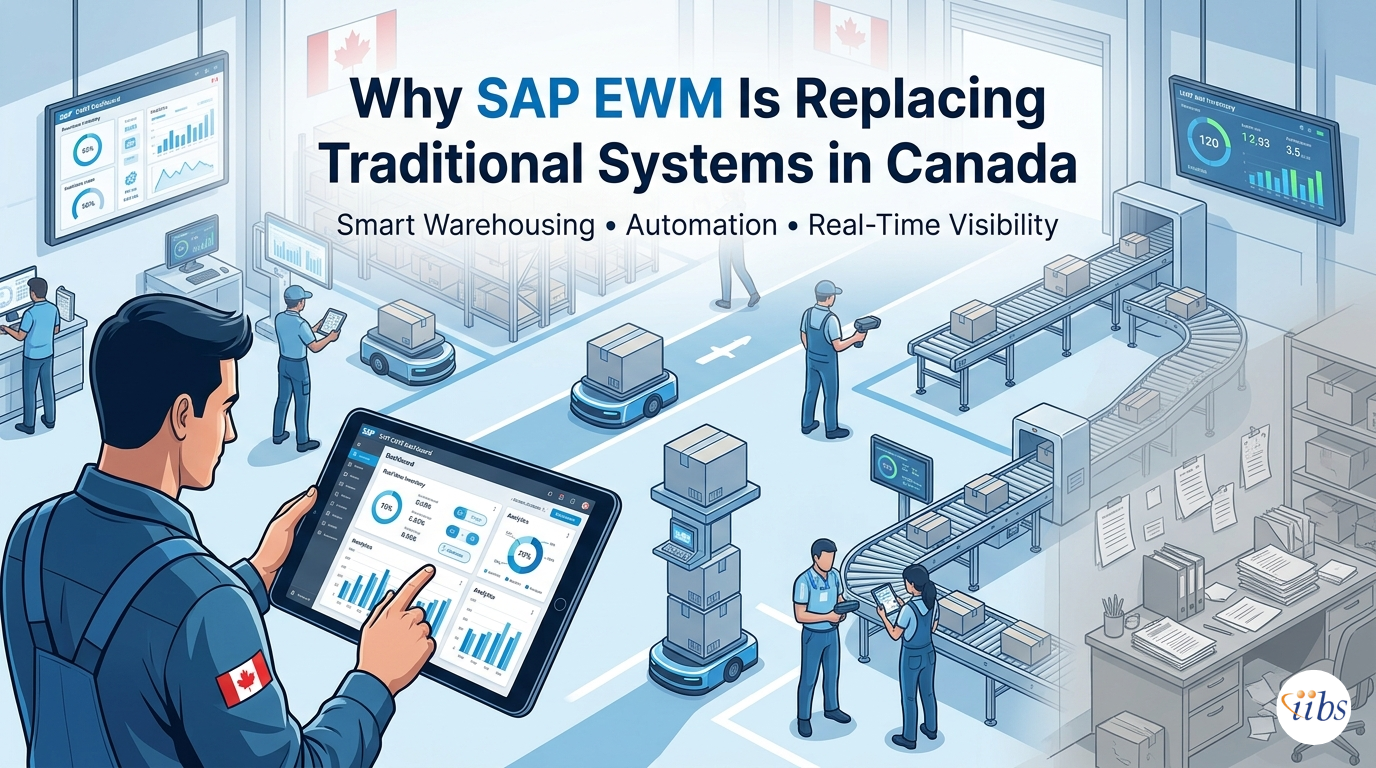
Why SAP EWM Is Replacing Traditional Systems in Canada
Canada’s supply chain sector has been under significant pressure in recent years — from pandemic-era disruptions and labour shortages to growing e-commerce volumes and cross-border trade complexity. These pressures have accelerated the shift toward more intelligent, integrated warehouse platforms.
- Canadian E-Commerce Growth
Canada’s e-commerce market is projected to exceed CAD $60 billion by 2026, according to industry analysts. Fulfilling thousands of online orders daily requires warehouse systems that can handle complex split shipments, real-time inventory updates, and carrier integrations that most traditional WMS platforms struggle to support at scale.
- Multi-Site Operations
Many Canadian distributors and retailers now operate national warehouse networks spanning multiple provinces. SAP EWM’s multi-site management capabilities — where a single system manages inventory, transfers, and labour across all locations in real time — is a significant advantage over traditional systems that typically require separate instances per location.
- Labour Shortages and Automation
Canada’s ongoing warehouse labour shortages have pushed companies to invest in automation — robotics, AGVs (automated guided vehicles), and conveyor systems. SAP EWM is designed to integrate directly with warehouse automation equipment through its Material Flow System (MFS) module, making it the natural software backbone for smart warehouse projects.
- Regulatory and Trade Compliance
With tightening customs regulations and increasing requirements for product traceability (particularly in pharmaceuticals, food, and automotive sectors), Canadian companies need warehouse software with robust compliance and serialization capabilities — areas where SAP EWM significantly outperforms legacy platforms.
According to a 2026 Gartner Magic Quadrant for Warehouse Management Systems, SAP remains a Leader in the WMS category, recognized for its ability to execute at enterprise scale and its vision for the future of intelligent warehousing.
Job Market Demand for SAP EWM in Canada in 2026
The talent gap in SAP EWM is real, and Canadian employers are feeling it. As more enterprises complete their migration from legacy ERP and WMS platforms to SAP S/4HANA, demand for professionals with hands-on EWM knowledge has surged.
A quick review of Canadian job boards in 2026 reveals strong demand for roles including:
- SAP EWM Functional Consultant — typically commanding CAD $90,000–$130,000 annually
- SAP S/4HANA Supply Chain Analyst — roles in manufacturing, retail, and 3PL sectors
- SAP WM/EWM Migration Specialist — high demand as companies transition from legacy SAP WM
- Warehouse Systems Analyst — hybrid roles combining business process knowledge with EWM configuration skills
- SAP EWM Project Manager — overseeing EWM implementation and go-live projects
Industries hiring most actively include automotive (with major assembly plants in Ontario), pharmaceutical distribution, grocery and FMCG retail, and Canada’s rapidly growing third-party logistics (3PL) sector.
Toronto, Montreal, Vancouver, and Calgary represent the primary hiring hubs — though remote and hybrid SAP consulting roles are widely available across the country.
SAP S/4HANA EWM Training in Canada: What to Look For
For professionals looking to enter or advance in this space, structured training is the most reliable path to marketable skills. Not all SAP training is equal, however — the best programs combine conceptual understanding with hands-on system access, real-world business scenarios, and guidance from practitioners who have delivered actual EWM implementations.
When evaluating an SAP S/4HANA EWM Online Course in Canada, consider the following:
- Hands-on SAP system access — theory alone won’t prepare you for client projects
- Coverage of core EWM processes — inbound, outbound, internal movements, slotting, labour management
- Integration topics — how EWM connects with SD, MM, PP, and TM
- Post-course support — exam prep, project guidance, or job placement assistance
- Instructor credentials — look for instructors with real implementation experience
IIBS offers a comprehensive SAP S/4HANA EWM course designed specifically for the Canadian market. The program is structured to take students from foundational warehouse management concepts through advanced EWM configuration, with a curriculum that reflects current industry practices and SAP’s latest release features.
Whether you’re a recent graduate, a warehouse operations professional looking to transition into consulting, or an IT professional expanding your SAP skillset, this type of structured, practical training can be the difference between browsing job postings and landing interviews.
The Importance of SAP S/4HANA EWM Certification
Certification sends a clear signal to employers: you’ve committed the time to learn the system properly and you’ve validated that knowledge against an objective standard.
SAP S/4HANA EWM Certification — specifically the SAP Certified Application Associate – Extended Warehouse Management with SAP S/4HANA (exam C_EWM_2020 or the latest equivalent) — is recognized by hiring managers and SAP implementation partners across Canada and internationally.
Benefits of pursuing certification include:
- Credibility with clients and employers — particularly valuable when entering consulting or changing industries
- Salary differentiation — certified professionals consistently command higher rates in contract and permanent roles
- Career mobility — SAP skills transfer across industries and geographies
- Access to the SAP partner ecosystem — many VAR partners and system integrators require certification for client-facing roles
Preparing for certification without formal training is possible but challenging — the exam covers a wide range of functional and technical topics that require both conceptual understanding and system familiarity. A quality SAP S/4HANA EWM Course will typically include exam preparation guidance alongside the practical curriculum.
The Future of Warehouse Automation: AI, SAP, and What’s Next
The warehouse of 2026 is smart. The warehouse of 2030 will be nearly autonomous. And SAP S/4HANA EWM is being built to support that trajectory.
Key trends shaping the next phase of warehouse technology include:
AI-Driven Slotting and Replenishment Machine learning models now analyze order history, seasonal patterns, and supplier lead times to dynamically optimize where products are stored and when to replenish them. SAP EWM’s integration with SAP IBP (Integrated Business Planning) makes this a live, continuous process rather than a periodic manual exercise.
Robotics and AGV Integration SAP EWM’s Material Flow System (MFS) is purpose-built for integration with conveyor systems, sorters, and autonomous mobile robots (AMRs). Canadian 3PLs and manufacturers investing in automation are increasingly standardizing on EWM as the control layer for their robotic infrastructure.
Digital Twins for Warehouse Design SAP and its partners are developing digital twin capabilities that allow warehouse managers to simulate layout changes, staffing models, and process redesigns before implementation — dramatically reducing the risk of costly operational disruptions.
Sustainability and Carbon Tracking Supply chain sustainability is a growing regulatory and corporate priority in Canada. SAP’s platform now supports carbon footprint tracking at the shipment and process level, giving companies the data they need for ESG reporting and emissions reduction initiatives.
Generative AI for Operations SAP’s Joule AI assistant, embedded across the S/4HANA platform, is beginning to surface in EWM contexts — helping warehouse managers ask natural language questions about inventory status, labour performance, and exception resolution. This marks a genuine shift in how warehouse professionals interact with enterprise software.
According to a recent McKinsey report on supply chain digitization, companies that fully digitize their supply chain operations achieve 15–20% reductions in operational costs — with warehouse management representing one of the highest-impact areas for technology investment.
Conclusion: The Time to Upskill Is Now
The comparison between SAP S/4HANA EWM and traditional Warehouse Management Systems in 2026 isn’t close. EWM offers superior integration, greater scalability, deeper analytics, and a technology roadmap aligned with where the industry is heading. For Canadian businesses running legacy systems, the question isn’t whether to migrate — it’s how soon.
For professionals, the opportunity is equally clear. As Canada’s logistics and supply chain sector continues to modernize, the demand for qualified SAP EWM consultants, analysts, and project managers will only grow. Positions in this space are well-compensated, geographically flexible, and increasingly central to how businesses operate.
If you’re ready to take that step, explore the SAP S/4HANA EWM Training in Canada offered through IIBS. Their SAP S/4HANA EWM course provides structured, hands-on training designed to prepare you for real-world implementation projects and SAP S/4HANA EWM Certification — giving you the credentials and confidence to compete in Canada’s growing SAP talent market.
The warehouses of tomorrow are being built today. The professionals who understand the systems powering them will be the ones shaping how Canada’s supply chains move forward.
Ready to future-proof your career in supply chain and logistics? Learn more about the SAP S/4HANA EWM Online Course at IIBS: https://iibs.ca/courses/sap-s4hana-ewm/